The latest ideas reshaping our places.
.avif)
.avif)
.avif)
%20(1).avif)
%20(3).avif)

Latest Podcasts

Why Cities Need Community Led Crash Analysis Studios
Around the Movement
The latest action and momentum from around the Strong Towns movement.

[[stc-widget-01]]
For West Allis, a small Wisconsin city about eight miles west of Milwaukee, becoming a strong town has required facing difficult realities head on and reaching for creative solutions.
After Allis-Chalmers, the city’s largest manufacturer, closed shop in 1999, the city’s economy nosedived. Thousands of people were laid off and many moved away. West Allis became a place people avoided. Being landlocked and completely built out, typical options for “recovery” were off the table. There was no big development to subsidize, no big employer coming in to save the day with thousands of jobs, no budget to pay a consultant.
But maybe that’s a good thing. After all, most of these typical “solutions” often only serve to drive cities into greater fiscal troubles down the line. Instead, city staff and leaders began reaching for a series of simpler but smarter actions they could take to make their town a more resilient place using the resources they already had.
“Without knowing it, they were reaching for Strong Towns solutions,” said staff planner Emily Wagner, who nominated West Allis for this year's Strongest Town Contest.
So what were the creative solutions they embraced? In 2022, they removed parking minimums and adopted maximums citywide. The reasoning was simple: “Density translates into value,” Economic Development Director Steve Schaer explained in an interview with me. “More brick and mortar rather than more parking lots [strengthens] our city’s tax base.”
They also reformed zoning to allow for more diverse types of housing. Since COVID, they’ve added 2,000 units of missing middle housing and in 2025, they legalized ADUs. These decisions have made West Allis attractive to more young people and also more affordable: they currently boast a 1.8% vacancy rate.
They’ve also intentionally come alongside small businesses, finding ways to help them grow and scale. From 2019 to 2022, they became a Kiva city, earmarking $100,000 as matching funds for entrepreneurs who secured Kiva funding. They’ve streamlined permitting processes and, through various financing programs, have helped business owners bridge various funding gaps, whether that’s their grant facade program or the Economic Development Loan Program, which exists to provide the capital that banks won’t. Red tape still exists, but by providing comprehensive roadmaps and a variety of resources, they hope to make it easier for business owners to jump through the hoops.

Seeking to become fiscally resilient, they’ve merged various city services with nearby communities to save money. In 2024, they merged health departments with the nearby city of Greenfield and earlier this year, they merged fire services with the city of Wauwatosa, a move that will save them $7 million over five years and allow them to qualify for State Innovation Fund grants, which could bring in $16–21 million each over the same time period.
Like many post-industrial cities, West Allis has its challenges. They have to work hard to compete for developers willing to work on brownfield sites without the typical incentives (Wagner told me they try to be very careful about how they use TIF funding schemes). Downtown’s main street is a state-owned trucking route, making it a tough place to foster the level of foot traffic needed to support local businesses. They’ve received some resistance from business owners and other residents who chafe against the idea of change.
But for a city like West Allis, there is no other option: “It’s 'grow or die,'” as Schaer put it in his conversation with Norm Van Eeden Petersman on the "Bottom-Up Shorts" podcast. Surviving into the future requires them to do things differently. Relying on one large employer, prioritizing suburban-style development and accepting car-oriented downtowns aren’t viable options anymore.
For West Allis, it’s all about appreciating what it already has and finding ways to build upon that. “The city is very resilient,” Schaer said. “We’ve got great amenities to work with: sidewalks throughout most of the community, a grid network of streets, public transportation, a farmer’s market … we’re really trying to build upon those amenities and overcome some of the stigma from the past.”
.avif)
[[stc-widget-01]]
After a car went through the windows of Mother Fool coffee shop in Madison, Wisconsin, three times, a few members of the Madison Strong Towns Local Conversation group decided enough was enough. There had to be something they could do to slow traffic and make the street safer for people walking, employees, and customers. Upon close examination, they realized that a lane closest to the sidewalk usually reserved for parking was opened up during rush hour to make the street wider (a peak-hour driving lane) and drivers tended to respond to this extra space by speeding.
At city meetings, they presented an idea: why not simply keep that lane for parking even during rush hour? It took some convincing across both city staff and city leaders, but eventually, they decided they could try something other than the usual process (waiting several years and getting the approval of an expensive consultant). They could simply put bags over the signs and allow the lane to serve for parking at all hours.
According to results shared by the city, most non-drivers were happy about improved safety:
- 88% of pedestrians felt safety has improved or is the same.
- 80% support removal of the lanes, with bicyclists and transit users topping this list.
- Residents on Willy Street supported removing the lane at 76% and residents within two blocks were at 54%.
- Businesses were slightly less enthusiastic, but 65% cited no effect on business.
The city ultimately decided to keep the lane for parking only. This experiment is a perfect snapshot of how the city of Madison is learning to embrace incrementalism and try small ideas in response to their challenges. This kind of incrementalism is a powerful approach to community improvement because it’s low cost, allows participants to learn from experiments and adapt to the new information, and it's agile: there were no high-cost, permanent materials in this project, just bags slipped over signs.
For Josh Olson, leader of Strong Towns Madison, this openness to incrementalism is critical to what makes Madison a Strong Town (and is part of the reason he nominated Madison for this year's Strongest Town Contest). “These discoveries are why we need more tests,” he writes on his Substack blog, "Counting Cranes." “If we hold onto assumptions like they are permanent, we will never learn or experience positive outcomes without extensive resources.”
Their work is inspiring other organizations who have found city rules and regulations too confusing to try tactical ideas. For example, last September, Strong Towns Madison successfully hosted a Park(ing) Day event, a process that required not only securing a permit from the city but also securing their own barriers to block the street off, a rule they didn’t know about until the day of. A friend hitched a trailer to his bike and hauled the barriers to the event just in the nick of time.

These successes are important not just for the tangible results they achieve but also because they represent a shift in mindset and culture. Typical interventions in these kinds of situations usually involve spending hundreds of thousands of dollars and several years on consultants and research. By learning to make small investments in temporary experiments, Madison is learning a new approach.
Helping city leaders and residents become comfortable with this approach is neither easy nor quick, but it’s the foundational work that will pay off later. For example, when the head of the transportation department attended the Park(ing) Day event, he expressed a willingness to make the process easier once he heard about their challenges. Other organizations reached out upon seeing their success thanking them for doing it and asking for a roadmap so they could try, too. “Our hope is because we took this step and we fought through that red tape that other groups will be able to do this next year,” Olson said.
Changing culture is an uphill battle for sure. But they are making progress. After successfully convincing the city to narrow one street by one lane, he’s seen the idea of street diet experiments become more popular at the city level and more readily embraced. For him, that’s the result of showing up, being polite and proposing a simple idea: let’s just try.
That’s how Madison is becoming stronger, one experiment at a time.
.avif)
.avif)
Crystal City, Virginia, is often held up as a model of large-scale, transit-oriented development. But despite billions in investment and decades of planning, it has struggled to produce something essential: places where people actually want to gather.
This isn’t an accident. It’s the predictable result of how we approach development. Crystal City shows how even well-intentioned master-planned projects can fail to create true “public spaces,” and why bottom-up action is important for creating and maintaining local public spaces.
Locked Into a 40-Year Plan
Large-scale development started in Crystal City in the 1960s by the Charles E. Smith company. Eventually, that landlord would end up owning most of the nonresidential property in Crystal City. They were quoted as saying, "How many men get to start with a blank sheet of paper and create a city?" It took years for the landlord to realize they had built a community, not just a city, and attempt to make community amenities.
In the 1970s, the landlord built a large underground mall known as the Crystal City Underground (or “the Underground”), with over a hundred retailers and a variety of restaurants. While the mall did support small business tenants, their existence was based on a shaky foundation of traffic from office workers. In the early 2000s, however, Crystal City started to lose many large office tenants that employed more than a third of its workforce. Stores in the Underground consequently started to close as they did not have enough foot traffic from remaining office workers and residents.
Arlington County hired an urban planning firm to create an updated plan for Crystal City. The plan was adopted in 2010 as the Crystal City Sector Plan, and was seen as a 40-year blueprint for how Crystal City would be developed.
This sector plan emphasized a focus on large developments with buildings up to 300 feet tall, 20,000 jobs, and 14,000 new residents in an area that is approximately 0.4 square miles. Recent high rise developments have demonstrated that the plan is being followed. At the same time, input from locals has been ignored, and empty space remains undeveloped.
The requirements of the sector plan incentivize compact developments that cost millions of dollars. Also, there is no process to modify the 40-year sector plan. These two factors have caused significant challenges for bottom-up, incremental change.
When Community Emerges … and Gets Pushed Out
Although Arlington County prioritized large-scale, top-down developments for Crystal City, bottom-up action has created public spaces in the Crystal City Underground that residents actually want to spend time in. Interference from the landlord, however, has threatened the success of these spaces.
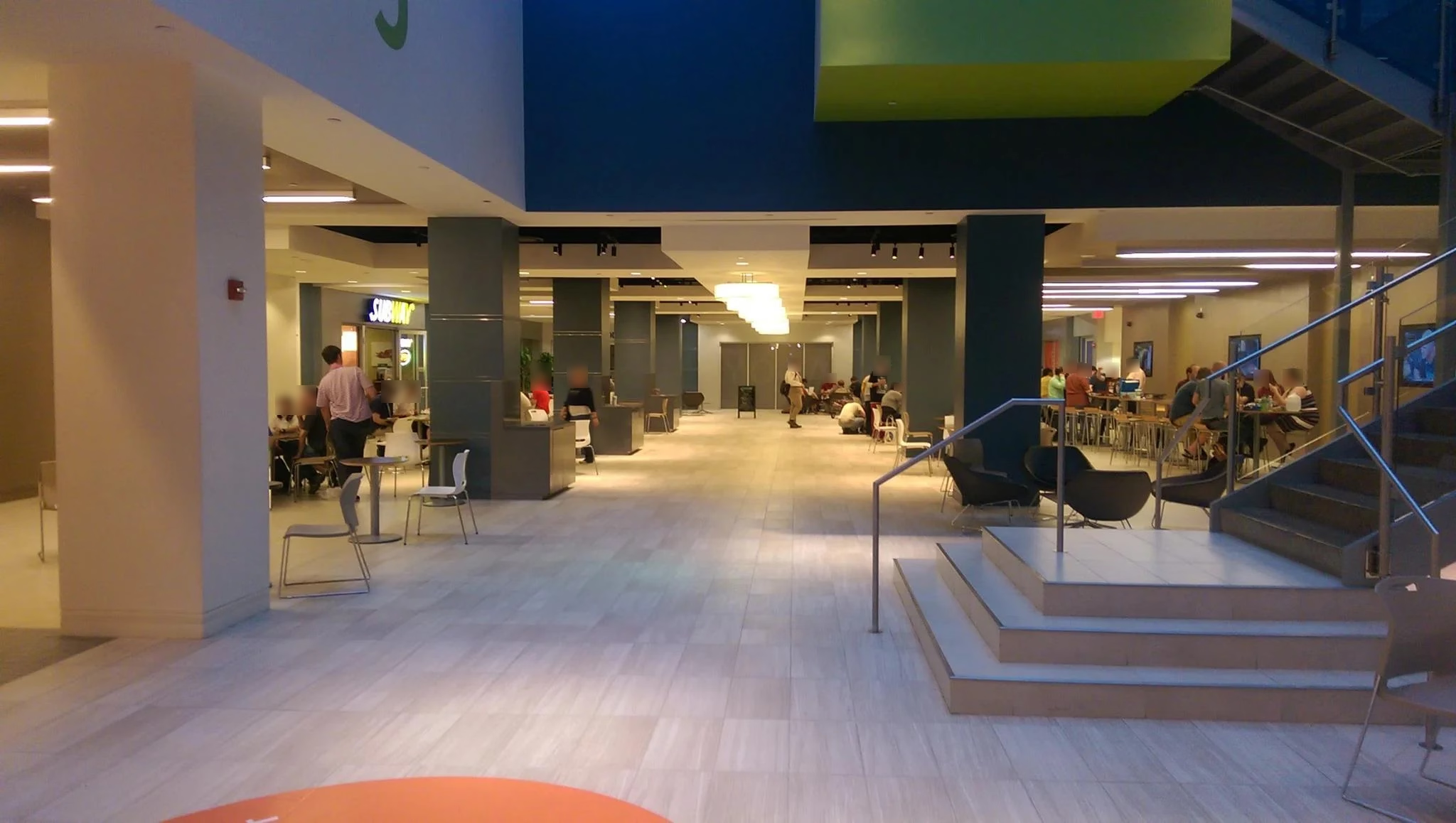
One of my personal favorite third spaces in the Underground was The Landing, a space where locals hosted informal events. Over time, around 100 people began gathering at The Landing on Friday nights between the board game nights I hosted and other groups. People would also often meet there on evenings and weekends.
Unfortunately, when the landlord removed the tables and chairs in 2024, we didn't have any recourse. The landlord did not communicate clear plans for the Underground and was unwilling to work with community members to support alternative public spaces in Crystal City. Small businesses in the Underground were also forced to close around the same time.
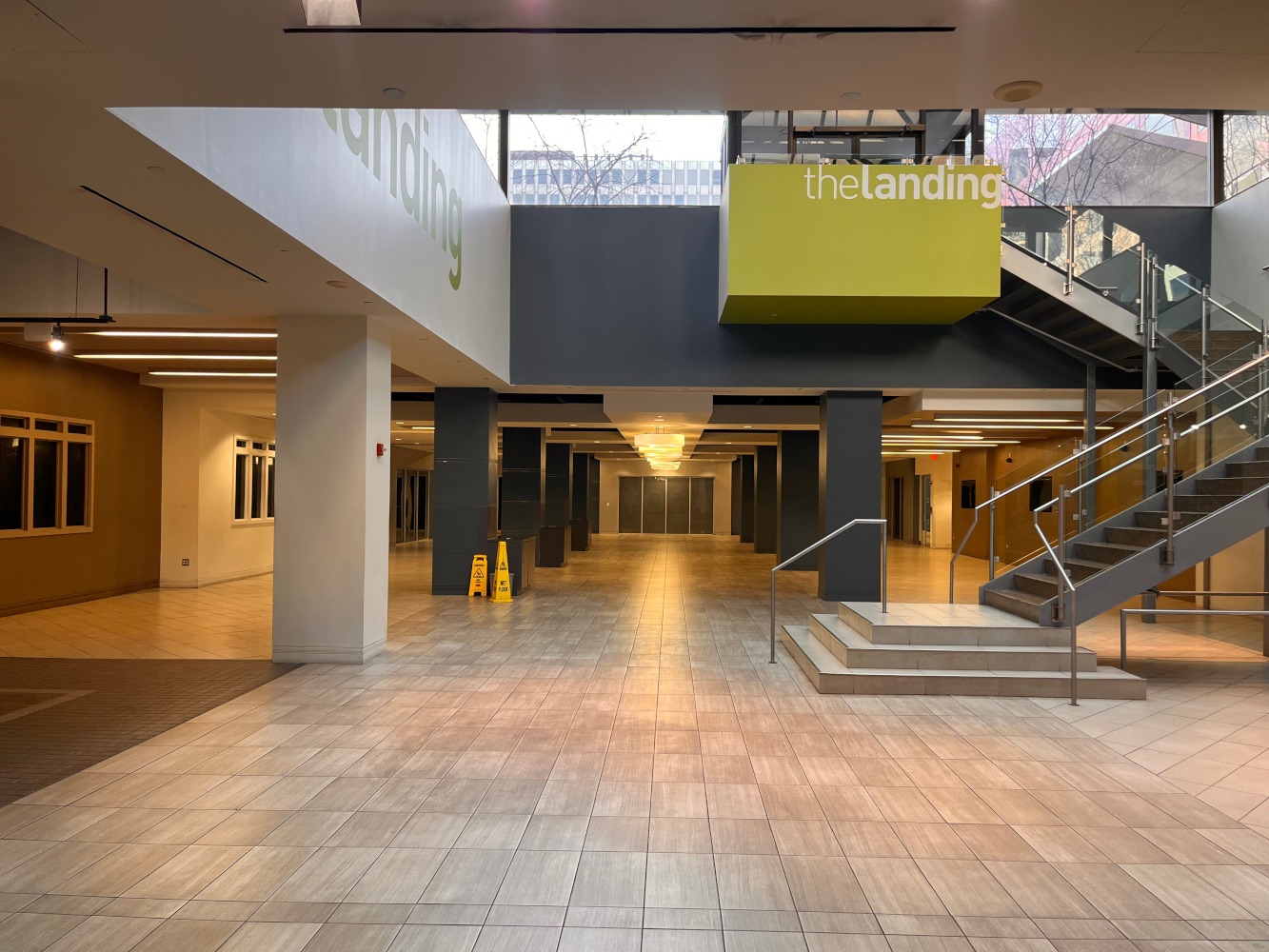
When I lived in Crystal City, I enjoyed being able to walk to The Landing and meet people there. The Landing also encouraged a culture of self-organizing and community ownership, which was reflected in the board game events I attended there. When an official host wasn't able to be there, other regulars, including myself, made sure things ran smoothly.
In 2016, Arlington County opened a pop-up library, called Connection Library, in the Underground after getting input from local residents. Local advocacy contributed to Connection staying open until 2019, although the original plan was to keep it open for nine months. This included the Crystal City Civic Association making a formal request to the county, and individuals reaching out to the Arlington County Board.
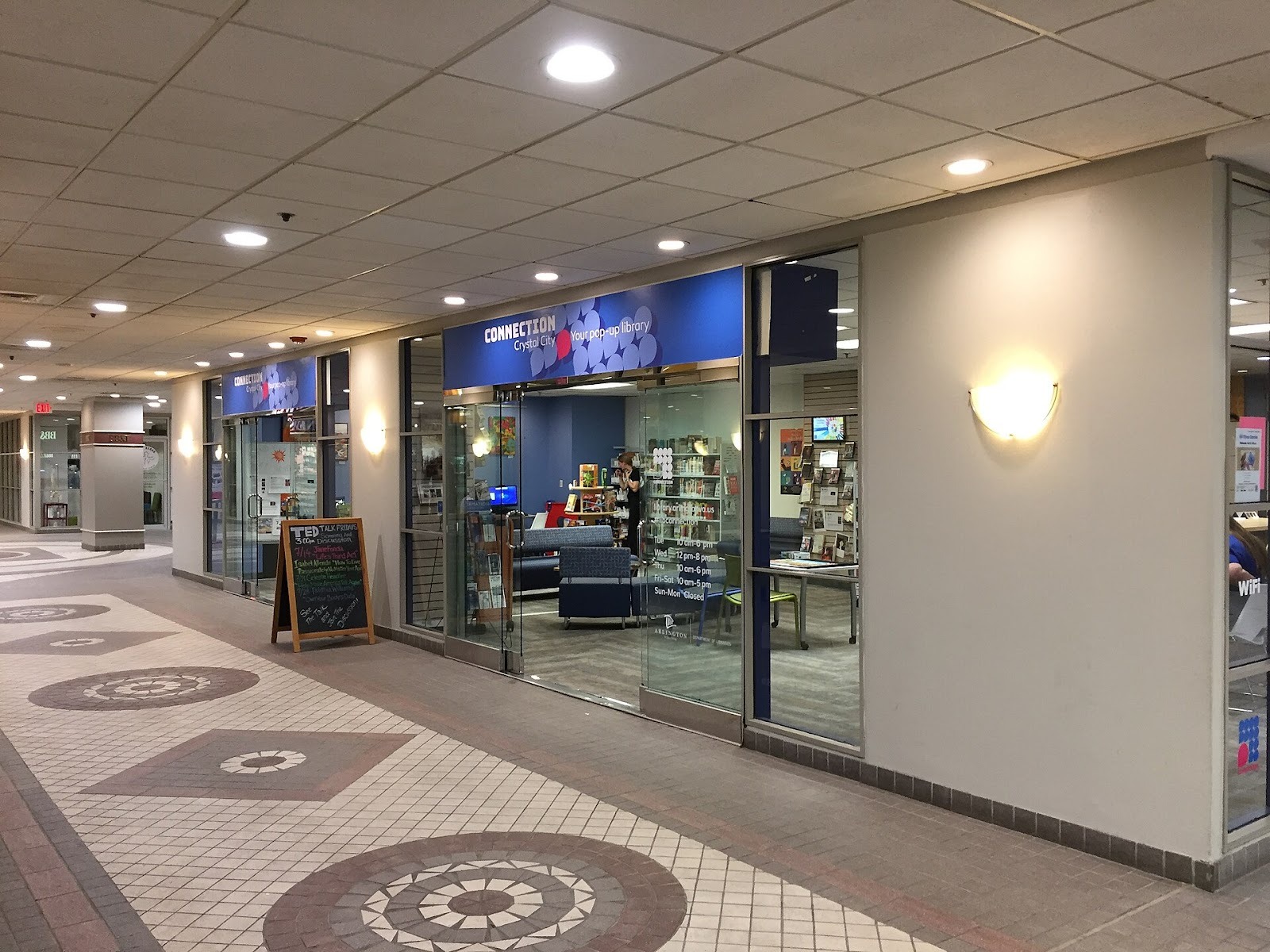
But then Connection closed in December 2019, because decreased attendance caused Arlington County to decide paying for library staffing was not a priority. A restaurant and makerspace nearby closed, which caused foot traffic to decrease. The landlord did not work with Connection staff to draw additional foot traffic or move the library to another available space for rent.
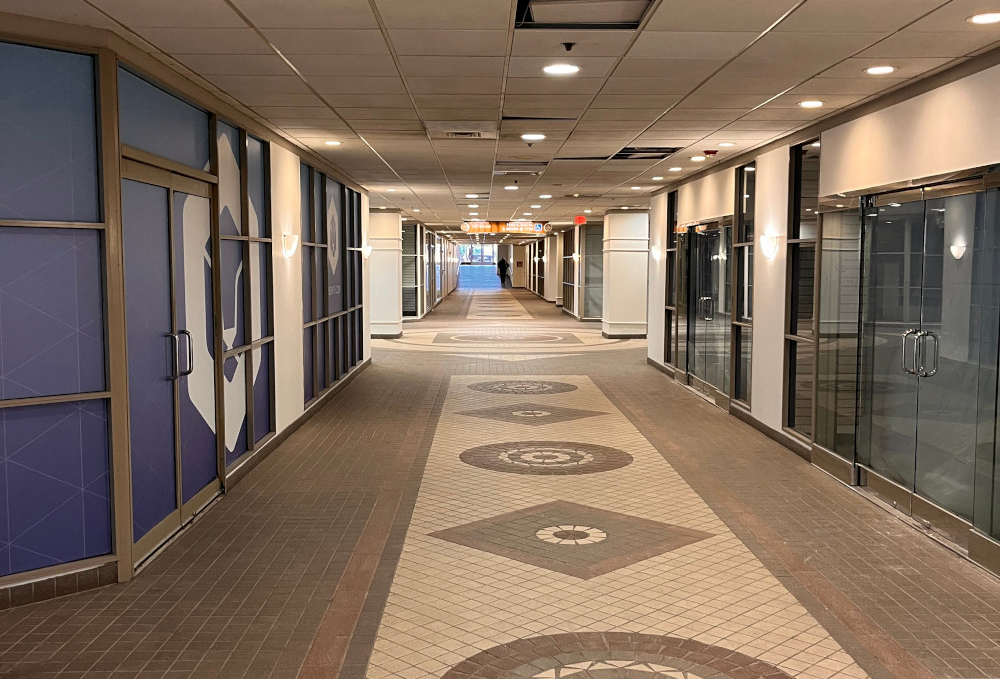
In 2022, the landlord agreed to build a new library as part of another development. However, the landlord was able to cancel the library plans by paying Arlington $5.8 million.
The Financial Case for Bottom-Up Growth
Community spaces make people more invested in the quality of their neighborhoods. They bring people together, helping form partnerships that lead to small, incremental improvements. Those same relationships can support the creation of small businesses, which generate jobs and build local wealth.
This kind of localized investment tends to be more stable than relying on a single large landlord, especially one that doesn’t live nearby. You can see this in the long-running success of the locally owned businesses along Crystal City’s 23rd Street.
By contrast, Arlington County has become increasingly dependent on large-scale development for its tax base, and that’s caused revenue challenges. In fiscal year (FY) 2025 and FY 2026, 56% of Arlington County's tax revenue came from property taxes, and that number is forecasted to go up to 57%. At the same time, the county’s proposed $1.69 billion FY 2027 budget is slightly smaller than the previous year, reflecting rising costs and slow revenue growth.
Recent assessments highlight the challenge. Property values increased by just 1.1% in January 2026 (the third consecutive year of slowing growth) while inflation reached 2.7%, with many services rising even faster. Meanwhile, homeowners are paying more: the average tax and fee burden is projected to reach $9,253 in FY 2027, up 55% from FY 2017.
Taken together, these trends point to a fragile model. When local governments rely heavily on large developments for revenue, they become vulnerable to slowdowns and rising costs, while missing the more resilient returns that come from widespread, small-scale investment.
Crystal City should move away from this overreliance on top-down development and toward a pattern that supports bottom-up growth. At the same time, any shift will need to account for the county’s current dependence on property tax revenue.
Concluding Thoughts: Recommendations for Local Officials and Residents
If Crystal City is going to become a place where people actually want to spend time, both local officials and residents have a role to play. Small, incremental changes can make a big difference, but only if the system allows them.
1. Reconsider how taxes are structured to encourage productive use of land.
Crystal City has indoor spaces that have been vacant for years, empty plots of land, and underutilized parking lots.
In Arlington County, property taxes are based on assessed market value. In practice, this penalizes owners who create, improve or maintain their buildings. Property owners may leave spaces vacant or hold out for higher rents, since potential rental income is reflected in property values. Maintaining a high value is important to protect the property’s value as collateral and prevent banks from foreclosing.
Arlington County should move to decrease tax rates on privately-created building values while increasing the rate on publicly-created land values. Increasing taxes on land while reducing taxes on improvements would encourage property owners to either put their spaces to productive use or sell them to someone who will. Arlington County already assesses land and building values separately, so this change would build on an existing system.
Over time, this approach could lower rents and reduce the need for large public spending on housing affordability. The proposed FY 2027 budget includes $98.1 million for housing affordability — an indication of how costly the current system has become.
(This article by Rick Rybeck gives some additional suggestions on how to advocate for changing the tax system!)
2. Use public spaces, and make that use visible.
Regular activity in public spaces signals demand. When people gather consistently, it becomes harder for property owners and local officials to ignore the need for places to meet, linger, and connect.
3. Advocate for local community spaces in conversations.
Advocacy helps people realize that spaces they walk by are community spaces. I learned The Landing in the Crystal City Underground was a community space through a conversation with a friend. I had walked by The Landing earlier in the year, and did not realize it was a popular site because it was almost empty at that time of day.
Word of mouth is a powerful force here: conversations help people see what’s possible, and help build support for keeping these spaces active and accessible.
4. Support community pop-ups and parks in empty spaces.
Pop-ups, temporary parks, and informal gathering spaces can turn underused areas into something meaningful with relatively little investment.
These small interventions create opportunities for people to test ideas, build relationships, and gradually improve their neighborhood without waiting for large-scale redevelopment.
[[divider]]
This article was originally published, in slightly different form, on the Create Third Places. It is shared here with permission.
.avif)
Editor's Note: Cities often discover, years after a neighborhood is built, that critical civic sites like schools, parks and libraries were placed next to the fastest and widest roads in the community. What follows is an attempt to fix that mismatch after the fact. The Township of Langley’s recent land swap to relocate a school site is a good example of how these decisions compound over time.
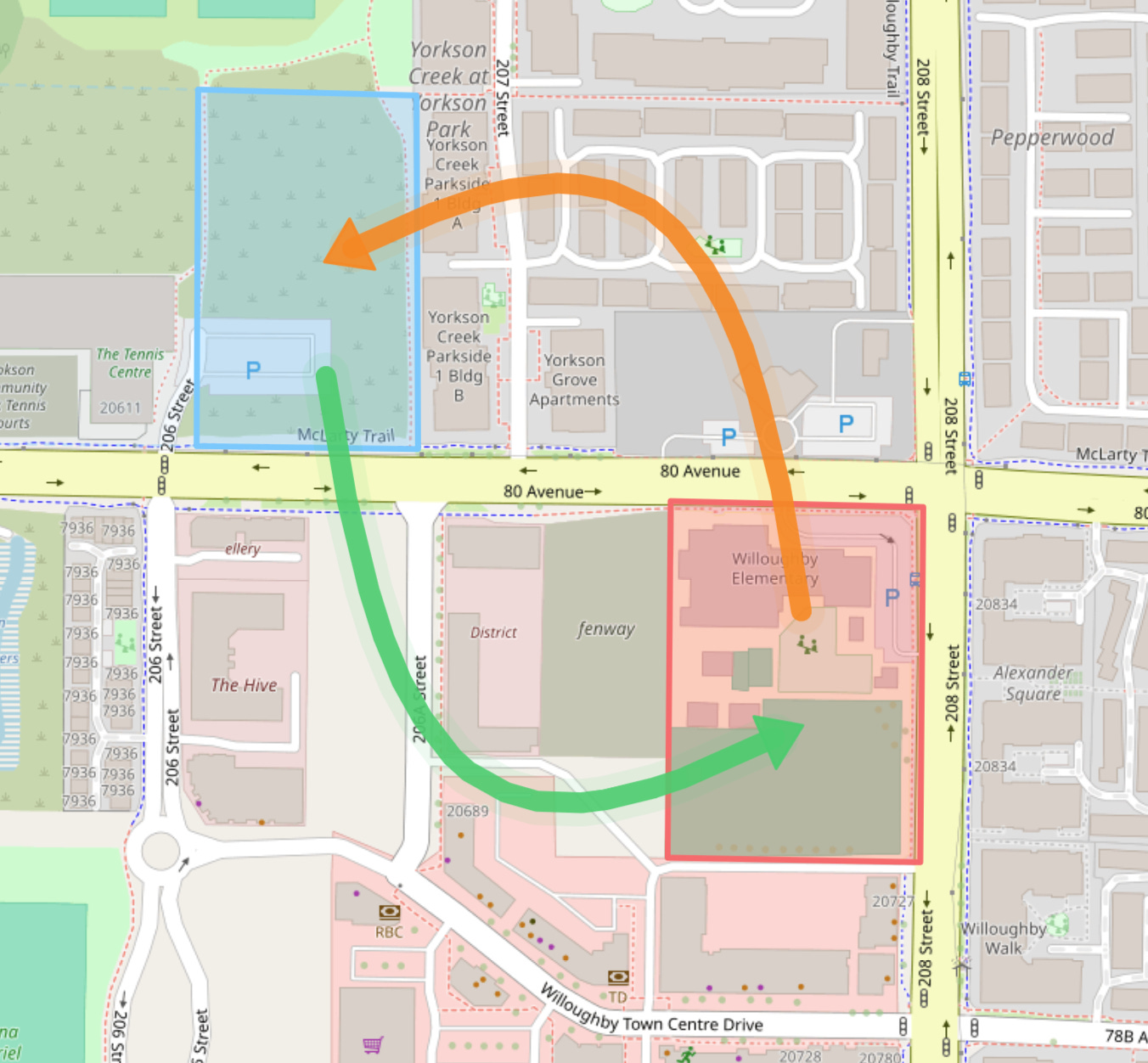
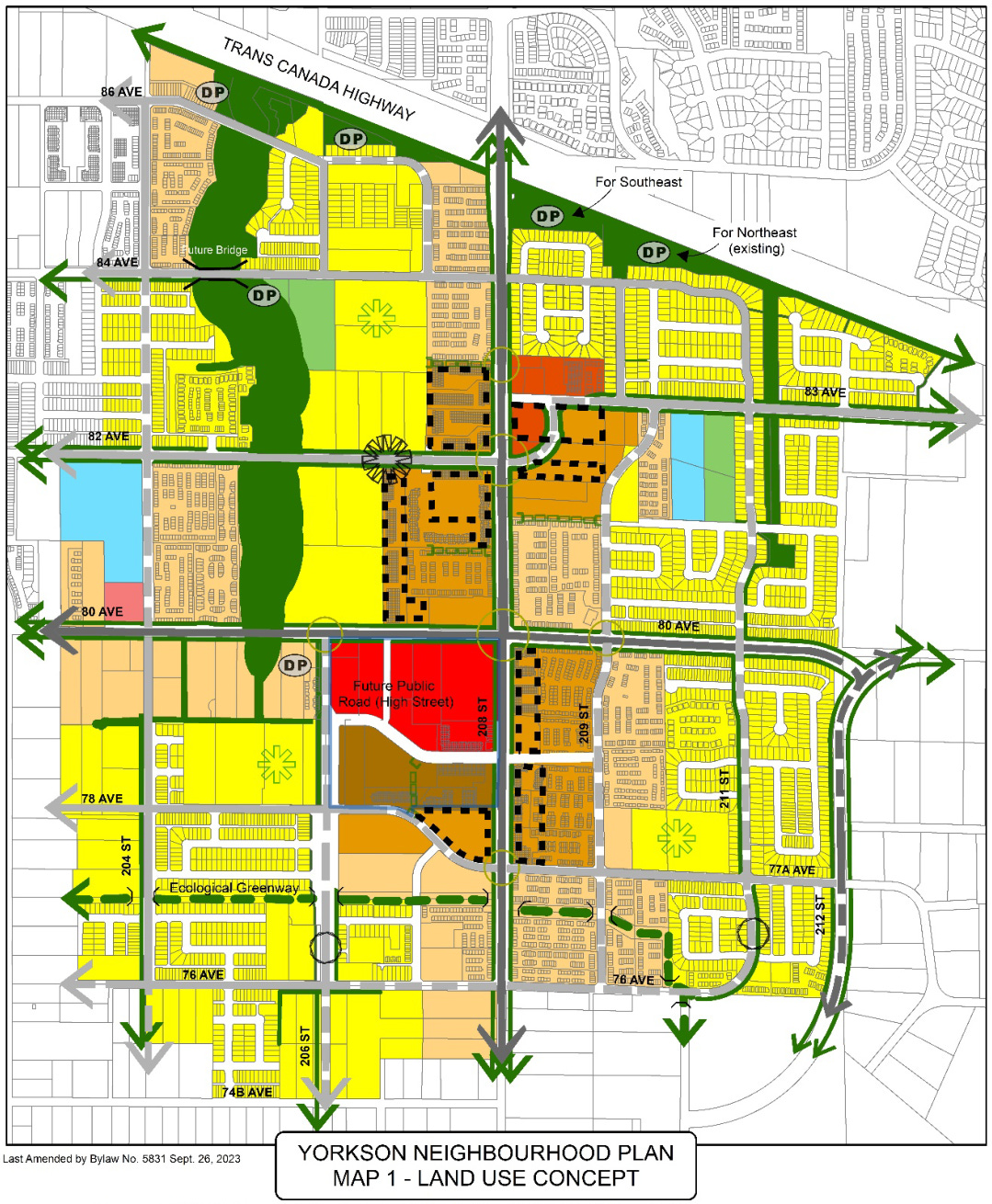
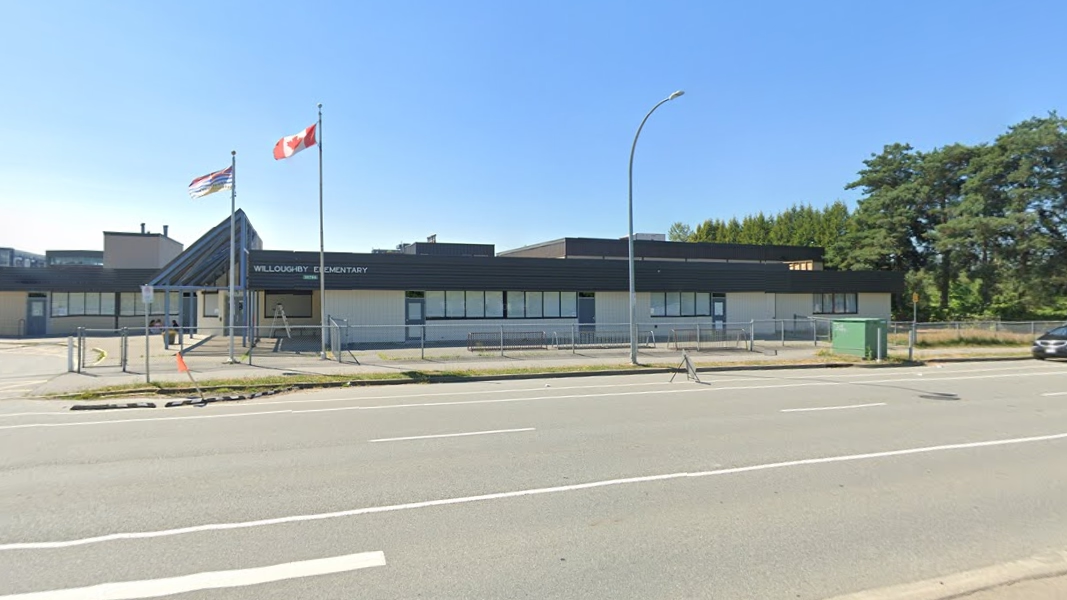
Last month, Langley, British Columbia, and the Langley School District announced an agreement where the township will pay to build a new school as part of a land swap deal. The deal gives the township the Willoughby Elementary School site at 208 Street and 80 Avenue (shown below), in exchange for the school district receiving a slice of land the township owns, located adjacent to the tennis center on 80 Avenue. This is being done to facilitate the construction of Willoughby Community Centre at 208 Street and 80 Avenue.
This land swap isn’t just a local real estate transaction, however. It’s an example of how cities sometimes have to unwind earlier planning assumptions when they collide with real life.
So What Is This Land Swap All About?
Planning began for a Willoughby community center back in 2023–2024, using the aforementioned vacant land near the tennis center, and was presented to the public at an open house in March 2024.
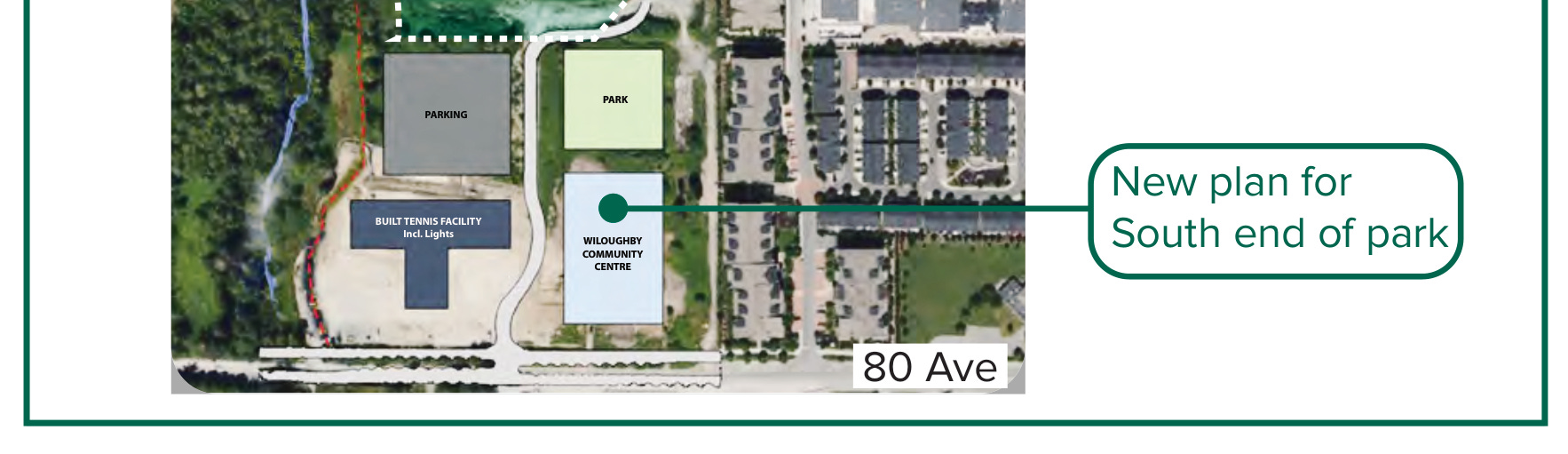
However, it’s clear concerns began to develop about using this site. In 2025, a second open house was held about the community center, which proposed building at 208 Street and 80 Avenue instead of Yorkson Park South. The larger site offered a number of benefits that addressed design and functionality limitations identified with the original location.
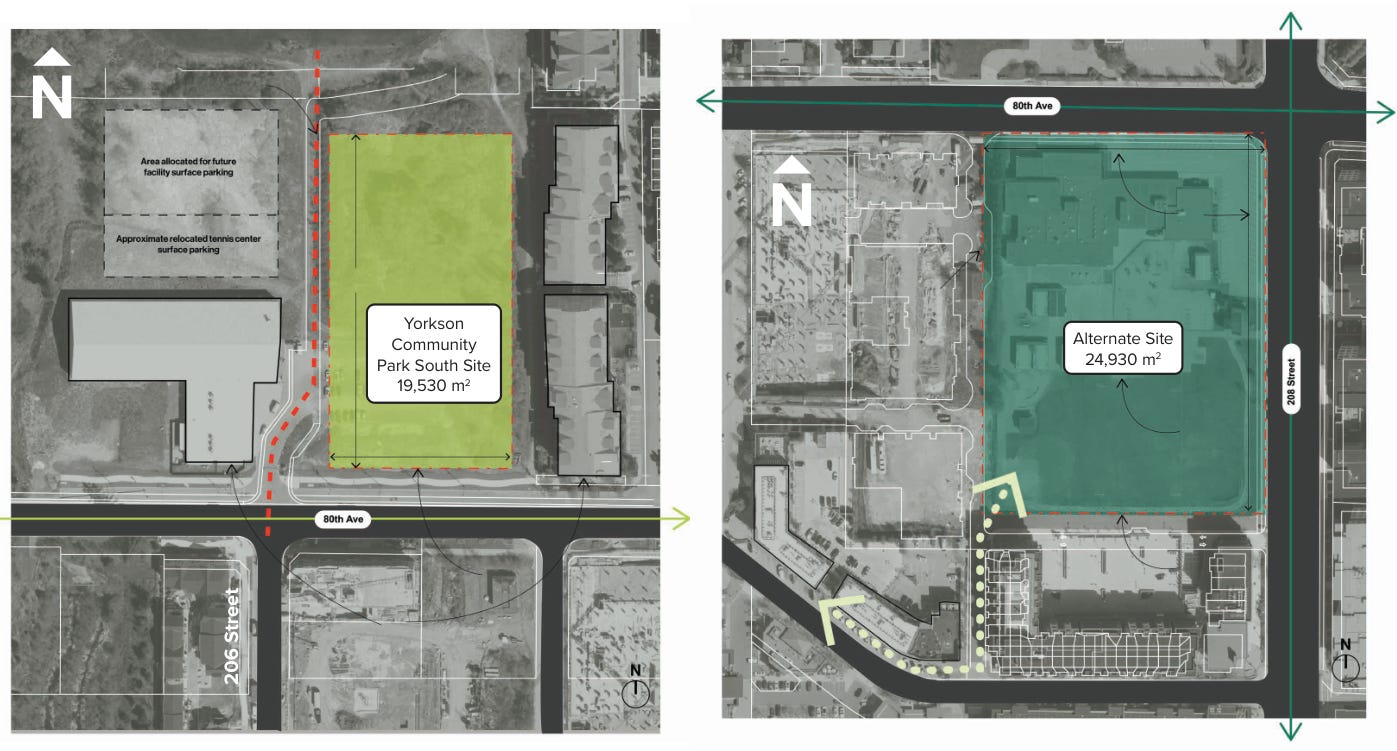
The Yorkson Park South site was certainly a simpler option: it’s vacant, readily available, and would have been faster and cheaper to build on. But its narrow 19,530-square-meter footprint was limiting. The 208 Street and 80 Avenue site, while requiring this complex land swap we’re now seeing, gives the Township 24,930 square meters to work with, much better integration with the surrounding urban area, improved building orientation, and the chance to create a real community hub.
Was It Worth the Delay and Extra Cost of Building a School?
The current administration has received a fair bit of flak for seemingly “rushing” to push a lot of things through quickly. In fact, the mayor has been quoted stating that “things never move fast enough for me” in relation to getting projects started and completed.
From a political perspective this approach is somewhat understandable: four-year election cycles combined with limited staff resources provide narrow windows for political leaders to show they are “getting stuff done.”
However, this often comes at the expense of better long-term planning. Many of the arterial roads in Willoughby, which we are now seeing constructed or completed, were surveyed and had engineering drawings filed many years ago, and these existing drawings, even though they are very wide and car-centric, were just picked up and implemented quickly under a debt-financed model due to political and time pressure. The only notable modification was adding concrete protection to the bike lanes, which (while this is a welcome improvement) were basically the maximum extent of the possible changes when using these existing plans.
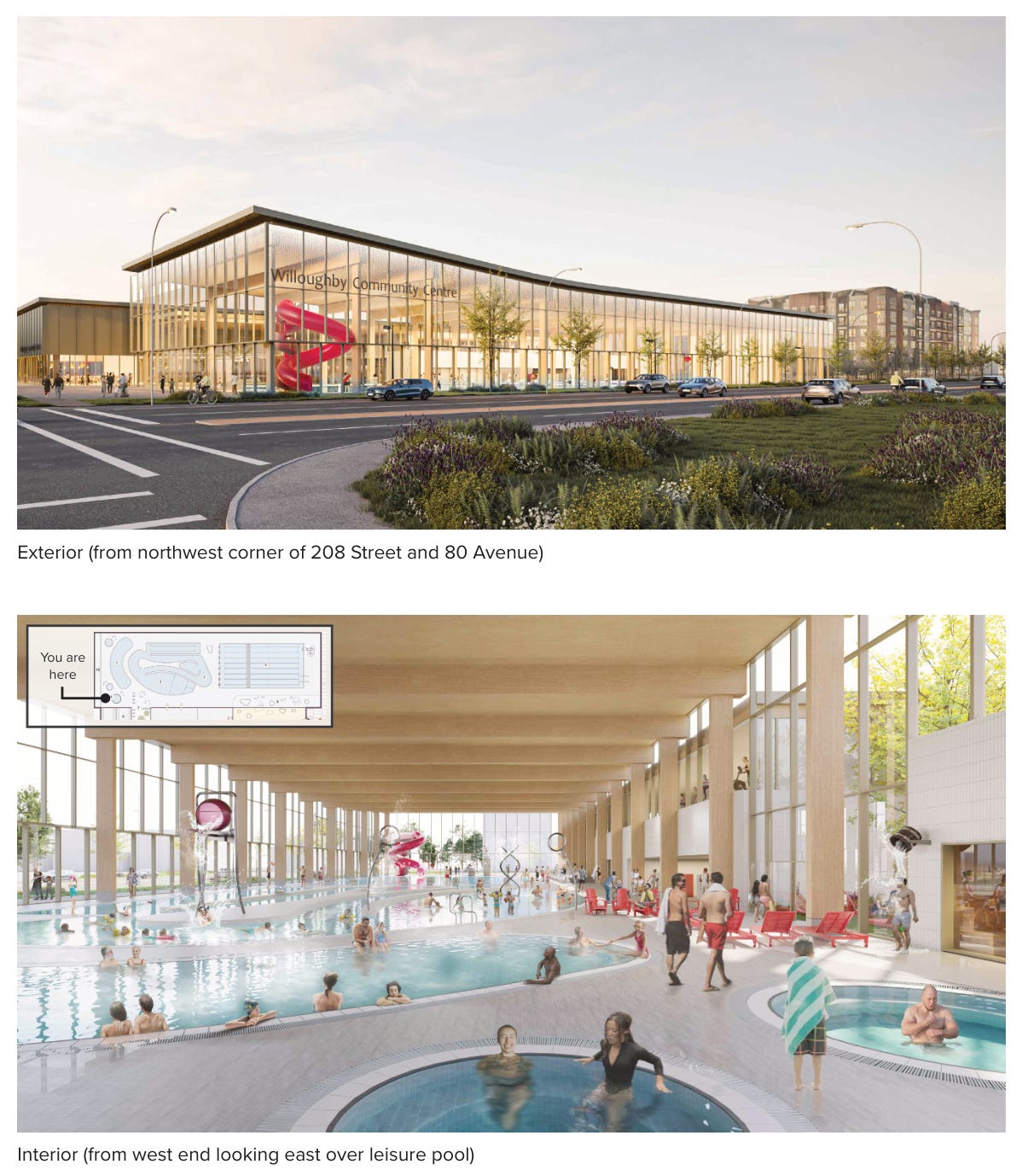
What’s notable is that this planning decision for Willoughby Community Centre is actually a surprising break from that approach. It is a better evaluation of community needs: an aging school located on a busy intersection, care and attention being paid to the overall urban fabric, and also the desire to build a larger community centre that won’t be bursting at the seams on opening day.
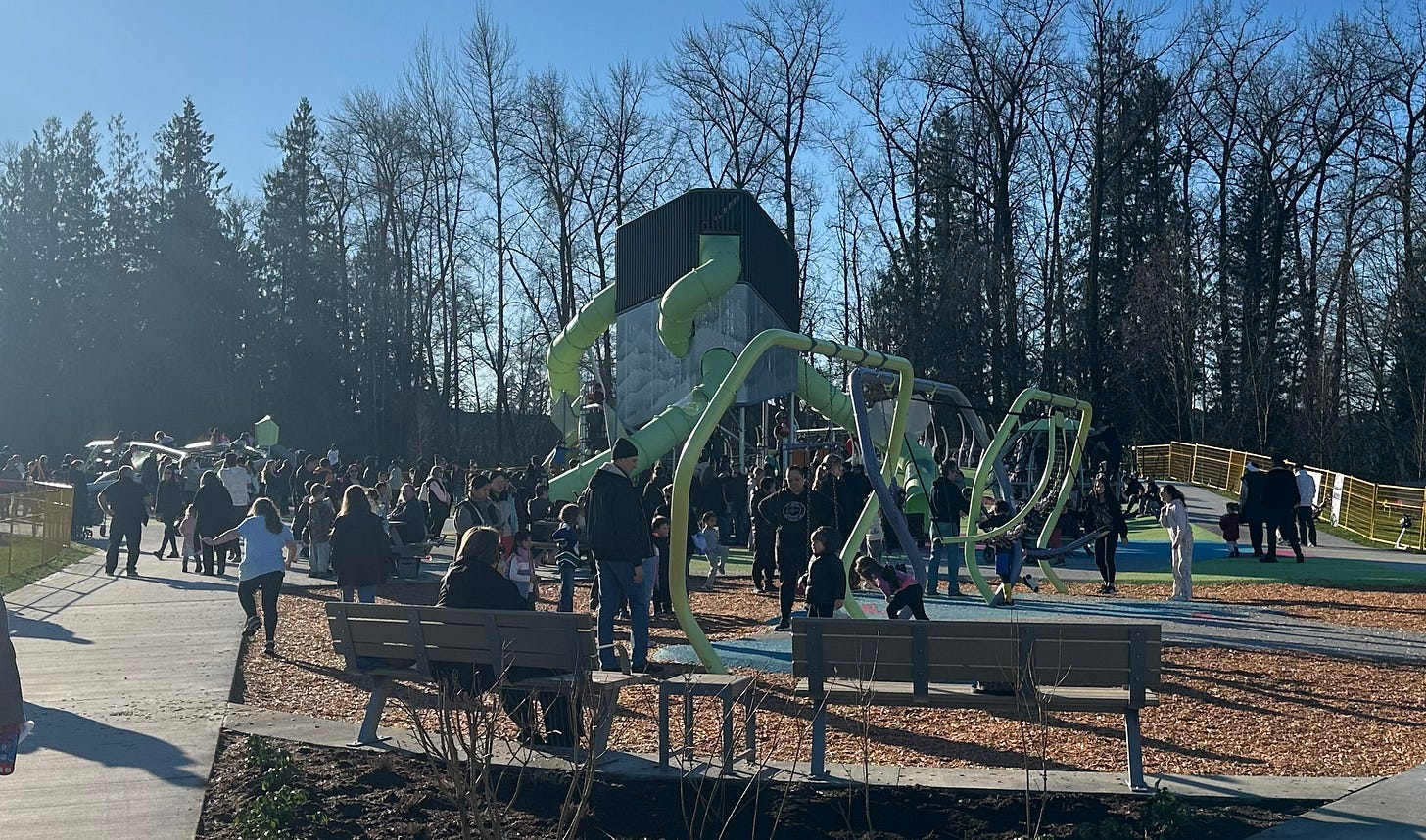
We’ve already seen what happens when something is underbuilt: schools in Yorkson that followed flawed student estimate formulas that need portables from day one. The brand new Yorkson Park Playground, while an excellent community asset, is overrun on the occasional sunny days we have at this time of year.
For the cost of building a school, the township gains an additional 5,400 square meters (58,125 square feet) of potential community center floor space — a larger site in a better location with no land acquisition costs. In this plan, parking will be built underneath the facility, which avoids the poor land use and less pedestrian-friendly environment of large amounts of surface parking, something particularly important in the urban centre of Willoughby.
If the township can also secure additional funding from the provincial and/or federal government, then it makes even more sense to try and get the best possible facility we can.
I also want to recognize that this reflects significant planning effort to squeeze in a facility large enough for the community right in the core of Willoughby, instead of building a “drive to” facility out of the urban center, which would incur more transportation investments and harm walkability and accessibility.
With all this in mind, I personally think it was worth it for the township to pay to build the new school. There is no cost estimate on this yet, but it cost the province $51.8 million to build Josette Dandurand Elementary in 2023, which gives some idea.
Others may disagree with this approach, and I won’t argue it’s another huge cost on top of accumulating debt, but it’s worth considering that buying more land to build a bigger community centre or a second facility sooner (at future higher construction costs) would have also been an additional expense.
Yorkson Was Planned Based on an Assumption That Never Came To Be
When planning the Yorkson neighbourhood in the early-to-late 2000s, planners felt confident that the Willoughby Elementary School, built in 1976, would be torn down and moved by the province. They went so far as to designate the school site as part of the Town Market/Town Centre area in the plan:
The Yorkson neighbourhood is expected to generate about 1,700 elementary students. This would require four elementary schools, including a replacement facility for Willoughby Elementary School. The Willoughby Elementary site is designated as Town Market and is anticipated to be redeveloped in the future for commercial or mixed use purposes.
- Yorkson Neighbourhood Plan, Section 5.3 Schools
This never happened. 208 Street and 80 Avenue were designated as wide arterial roads assuming that the school wouldn’t be there, or would be moved. The result we see today is young children exposed to poorer air quality and families who have to cross two busy, wide roads. This shows how the land swap deal is, at least partly, an externalized cost of that original assumption that never came to be.
Yet Another Symptom of Poor Arterial Road Placement
This outcome was also in part caused by planning neighborhoods to have a grid of hostile and busy arterial roads. In the original neighborhood plan, this might not have been foreseen as severe of an issue, as for the front of the school/town center area, the plan proposes 208 Street be scaled down to a street, with raised crosswalks and wide sidewalks.
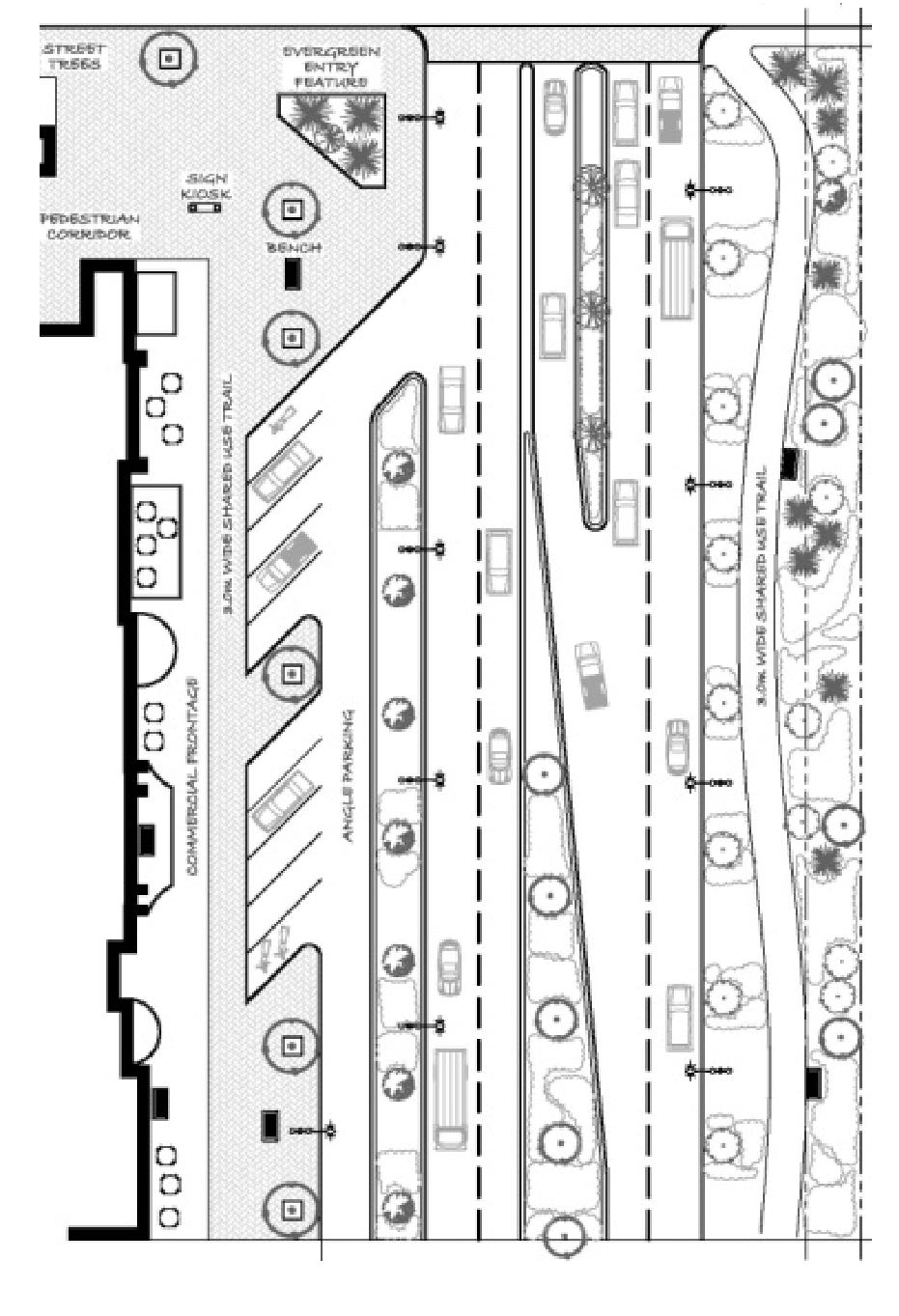
However, there is resistance to allowing or adding raised crosswalks like this on arterial roads. It’s seen as a form of traffic calming, most of which is not permitted or generally considered on arterials due to the current transportation planning approach.
If Yorkson had been designed with a perimeter arterial ring road, with an internal grid of narrow streets, this might not have become such a major issue. Instead, the plan called for a grid of wide arterials.
These arterial roads are not only expensive to build and maintain, they come with huge externalities not often considered: parking lots for all the cars, a higher number of fatal accidents, traffic calming on adjacent roads to prevent rat-runners, and now schools that have to be moved because we don’t want to expose children to vehicle exhaust.
There are institutional forces that continually push for these expensive and unnecessary arterial road grids, and this needs to be addressed, and we will continue to advocate for a better pro-active planning approach.
Thankfully there is a small ray of hope in that a road design is being considered for 208 Street in Brookswood:
2. 208 Street in Brookswood
Be it resolved that Council direct staff to Report to Council with potential design options and high-level cost estimates for upgrading 208 Street from 44 Avenue to 36 Avenue to an urban arterial standard. The upgrade should consider sidewalks, treed medians, and bike lanes, in accordance with the urban arterial road standards being developed as part of the Transportation and Mobility Study currently being finalized for Council’s review. The report shall include an analysis of both a two-lane urban arterial road and a four-lane urban arterial road.
The community/neighborhood plans call for this to be a four-lane arterial specifically, whereas this motion calls for a two-lane design to be considered. This is notable because this section of road runs in front of Brookswood Secondary School.
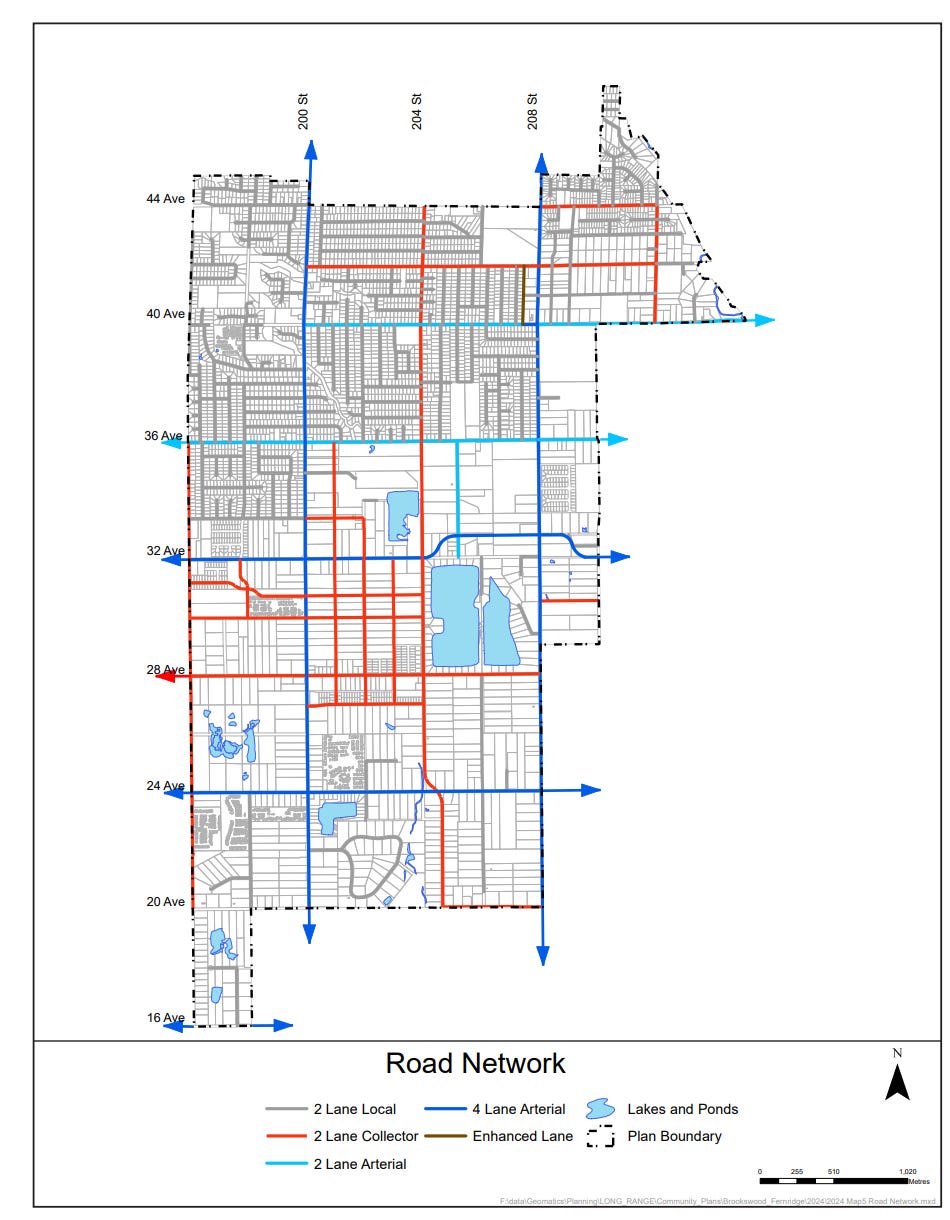
I hope that this reflects a small push toward improving Brookswood’s plans to eventually pare down its planned arterial grid, an approach that Willoughby has shown creates a pedestrian-hostile environment and comes with huge implications and costs.
In the same agenda is the final report of the Township-wide Parking Study and Bylaw Review. The report is worth reading in full, but this paragraph caught my eye:
Continue to prohibit on-street parking for new arterial road construction. Travel demands are projected to rise substantially within the Township. The Township has a limited amount of road space, which needs to be used efficiently. Prohibiting on-street parking on newly constructed arterial roads ensures that these corridors function as intended to safely and efficiently support higher traffic volumes, transit, emergency access, and goods movement.
To me, this is another clear signal that we need to keep arterials away from homes and businesses as much as possible. Arterials cannot effectively be used for on-street parking within the current paradigm, and as such, don’t belong in front of homes and business where people may wish to park and business owners may wish to have convenient parking. We don’t want people to fly by businesses at 60–70 km/h on their way somewhere else; we want them to slow down, stop and actually visit those businesses.
This parking study finding reinforces that our current approach to arterial road placement creates problems that cascade into other areas of planning. First we build wide, fast arterials through neighbourhoods. Then we can’t allow on-street parking because they need to move traffic efficiently. Then businesses struggle because customers have nowhere convenient to stop. Homes on busy roads become less desirable. And schools become hazardous for children because of the traffic volume and speed.
The report’s proposal to have no parking on arterials, along with the institutional resistance towards raised crosswalks on arterials we mentioned earlier, makes sense when we imagine arterial roads where they should be: on the outskirts connecting places quickly, not trying to be both a neighbourhood street and a fast connector simultaneously
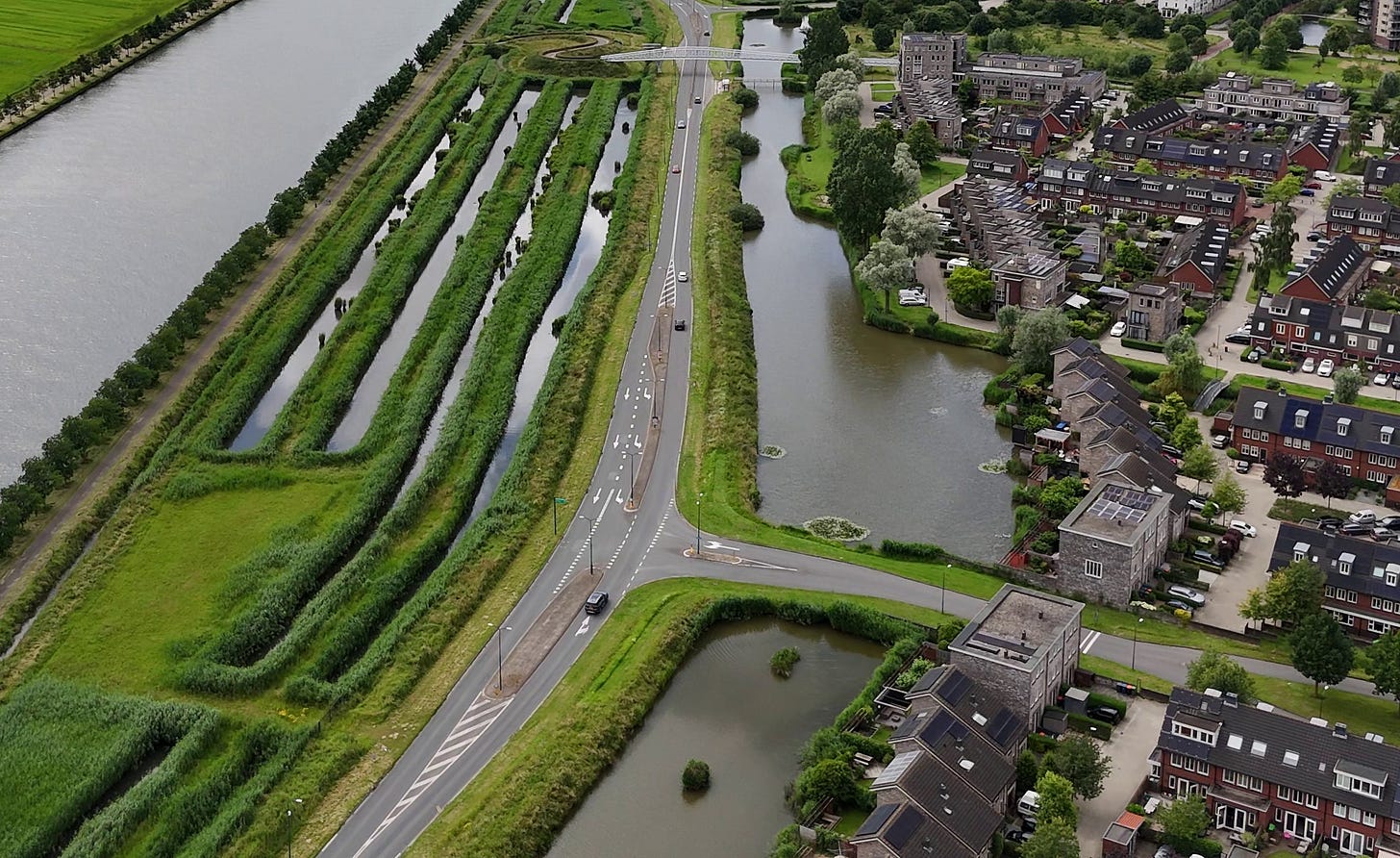
The Langley land swap is ultimately a small correction to a much larger pattern. For decades, we’ve designed suburban neighborhoods assuming wide arterial roads are necessary for growth. But those roads often create conflicts with the very places communities care about most: schools, parks, and neighborhood businesses.
Cities everywhere are now dealing with the consequences of those decisions. The question isn’t whether we’ll encounter these tradeoffs, but whether we’ll learn from them before repeating them in the next neighborhood.
[[divider]]
This article was originally published, in slightly different form, on the Strong Towns Langley Substack. It is shared here with permission.
Editor’s Note: This piece comes from a Strong Towns member examining how regulatory choices have shaped housing outcomes. The intent is not to prescribe a single solution, but to explore how incremental, locally grounded changes can influence affordability and neighborhood resilience—questions facing communities across North America.
[[divider]]
How big a difference could it really make if we changed just one letter in Longmont, Colorado's laws? What if that change could jumpstart meaningful progress toward housing affordability, walkability, bikeability, and the many other goals Longmont has set?
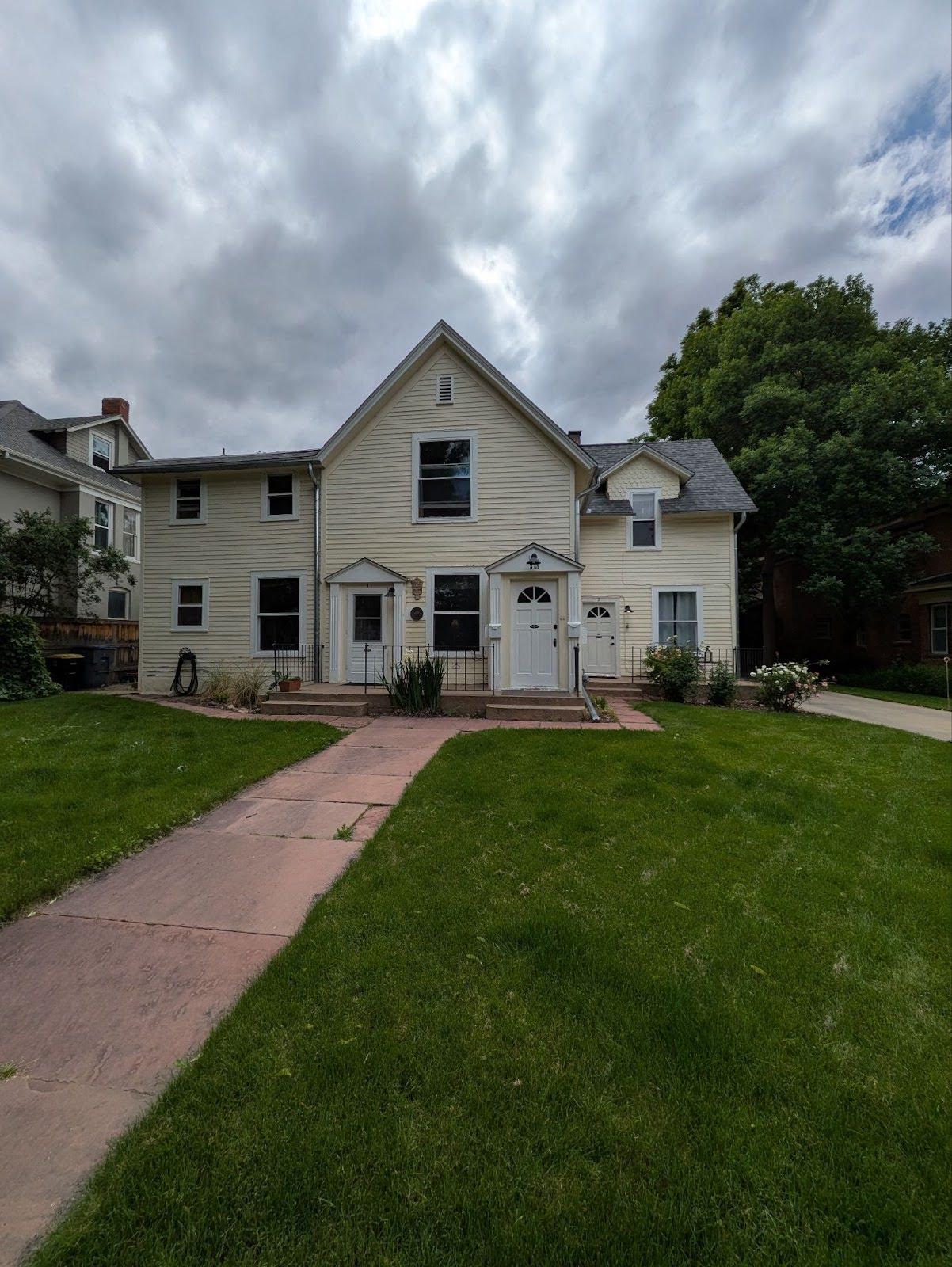
Buying a home or renting in Longmont has become dramatically more expensive over the past 15 years. The median home price in Longmont ($560,000), at current interest rates (6.15%) and with a typical five percent down payment, results in a roughly $3,600 monthly payment over 30 years. To avoid being cost-burdened by that mortgage, a married couple would need to earn around $200,000 annually—an income reached by only about 12% of Longmont residents and 16% of Americans.
Longmont is expensive in part because it’s an excellent place to live. Even at these prices, there are people willing to pay. But when only people with the highest incomes can afford to live in great places, something changes over time. Those places begin to lose the economic diversity that helped make them so attractive in the first place.
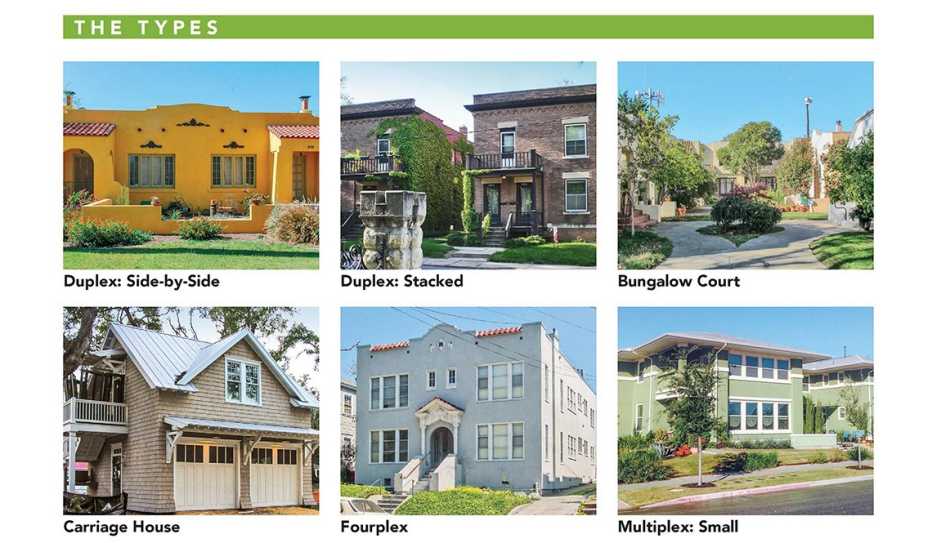
If we want to preserve a diversity of incomes in the city, we also need a diversity of housing types—single-family homes, townhomes, fourplexes, cottage courts—that use land in different ways and at different price points.
Nearby Boulder faced a similar set of choices from the 1970s through the 1990s. Rather than allowing neighborhoods to incrementally evolve over decades, the city adopted policies that significantly limited its ability to add housing as demand increased.
Over time, this has contributed to a city where many local businesses struggle to find employees who can afford to live nearby. Boulder is also experiencing a steady decline in families with young children, contributing to school closures and consolidations. Early-career households—teachers, nurses, service workers, young professionals—often find that they cannot gain a foothold, even if they hope to stay and invest in the community long term.
Some of these same dynamics now appear to be emerging in Longmont. Enrollment in the St. Vrain Valley School District has declined for three consecutive years, with Longmont accounting for much of that drop. Meanwhile, enrollment is growing in nearby Firestone, Frederick, and Erie. Those communities remain more affordable for young families, in part because they are still expanding outward—the same pattern that once kept Longmont's housing prices within reach before the city reached its greenbelt. As a consequence of this trajectory, Longmont voters are now poised to shoulder a large share of a $740 million bond to build new schools in other cities.
There's no question Longmont is at a crossroads. The question is, where do we go next?
How do we:
- Add homes while respecting our urban growth boundary?
- Create opportunities for people to own homes in Longmont, not just rent?
- Address housing shortages without relying on highly politicized large developments?
- Allow reinvestment in existing neighborhoods without triggering displacement?
- Help seniors age in place as property taxes rise and homes become harder to maintain?
One option is to continue doing what we’ve largely been doing: concentrating change in a limited number of areas. But when development is confined to just a few locations, new housing can feel disconnected from its surroundings and the stark contrast fertilizes the ground for backlash.
There’s another approach.
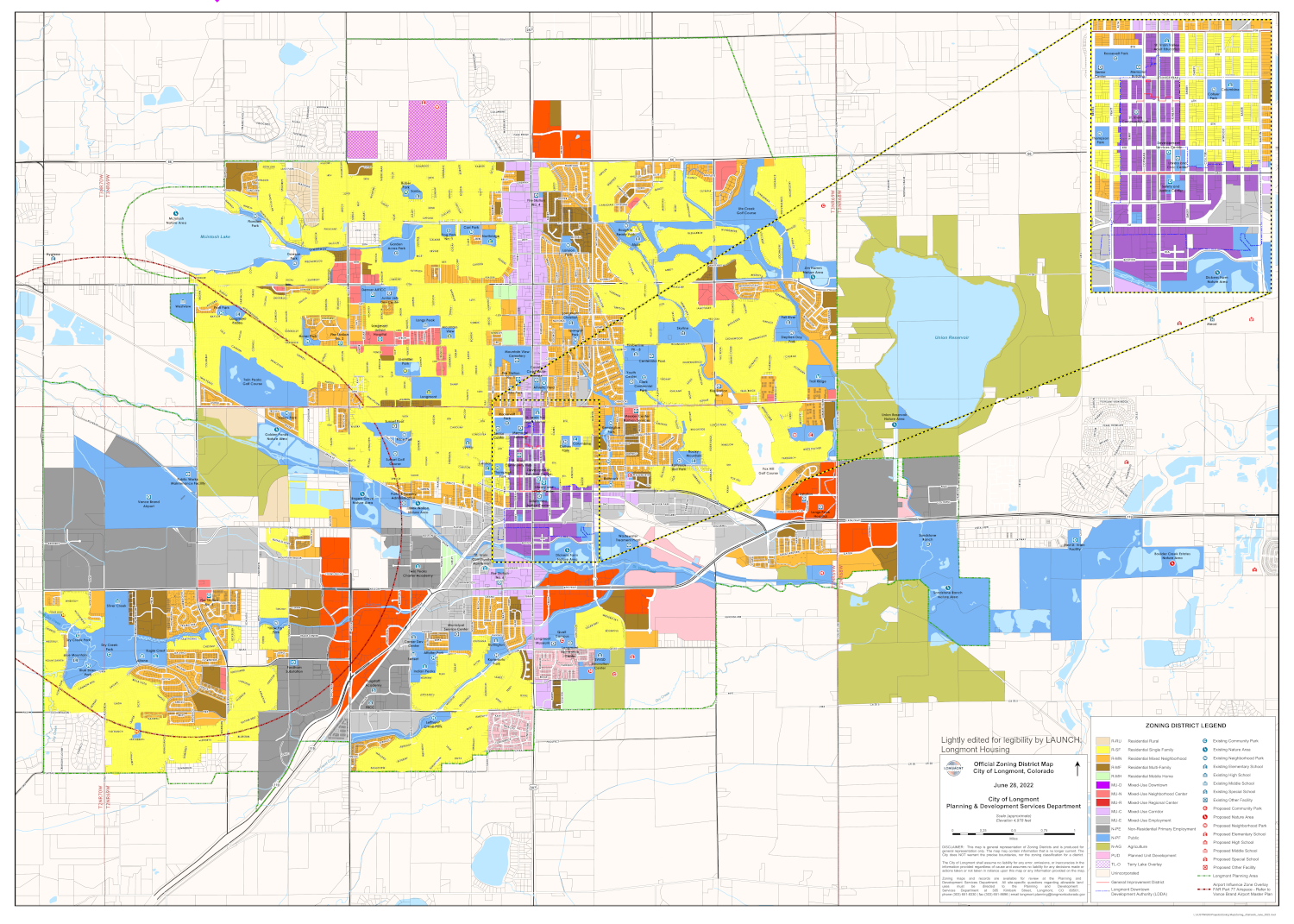
We could allow small, incremental change throughout the city. Specifically, we could legalize townhomes in neighborhoods that are currently locked into single-family zoning—areas experiencing what might be called “forced stagnation” (shown in yellow on the map below). This could be accomplished by adding the letter “P” to Table 15.04.020 of the Longmont Municipal Code.

Instead of intense development pressure on a handful of remaining vacant lots—often accompanied by long city council meetings and high-stakes debates—this approach would allow many small decisions, made by individual property owners, to shape the city gradually.
Converting an existing single-family home into a duplex or townhome can unlock opportunity across Longmont. It allows neighborhoods to evolve without dramatic change to their physical character, while avoiding the stagnation that preserves the physical appearance of neighborhoods while replacing the people who live there.
And because Longmont is a large city, the scale of change required is surprisingly modest. Roughly speaking, the city could address its housing shortage with something on the order of one fourplex every three blocks. This isn’t a boom—it’s a slow, distributed form of growth.
This kind of incremental change isn’t sexy—and that’s the point. It happens over time, spread throughout the city. But it may be the kind of change that helps Longmont remain a place where people at different stages of life and income levels can continue to put down roots. And to start, all we'd need to do is change one letter.

Philadelphia’s street grid is a mashup. Highways cut through neighborhoods. Major arterials run along the waterfront. Some residential streets are barely wide enough for a single car. Despite the variety, just about every inch of that street and road network is legally accessible by trucks, cars, and anything else with a motor.
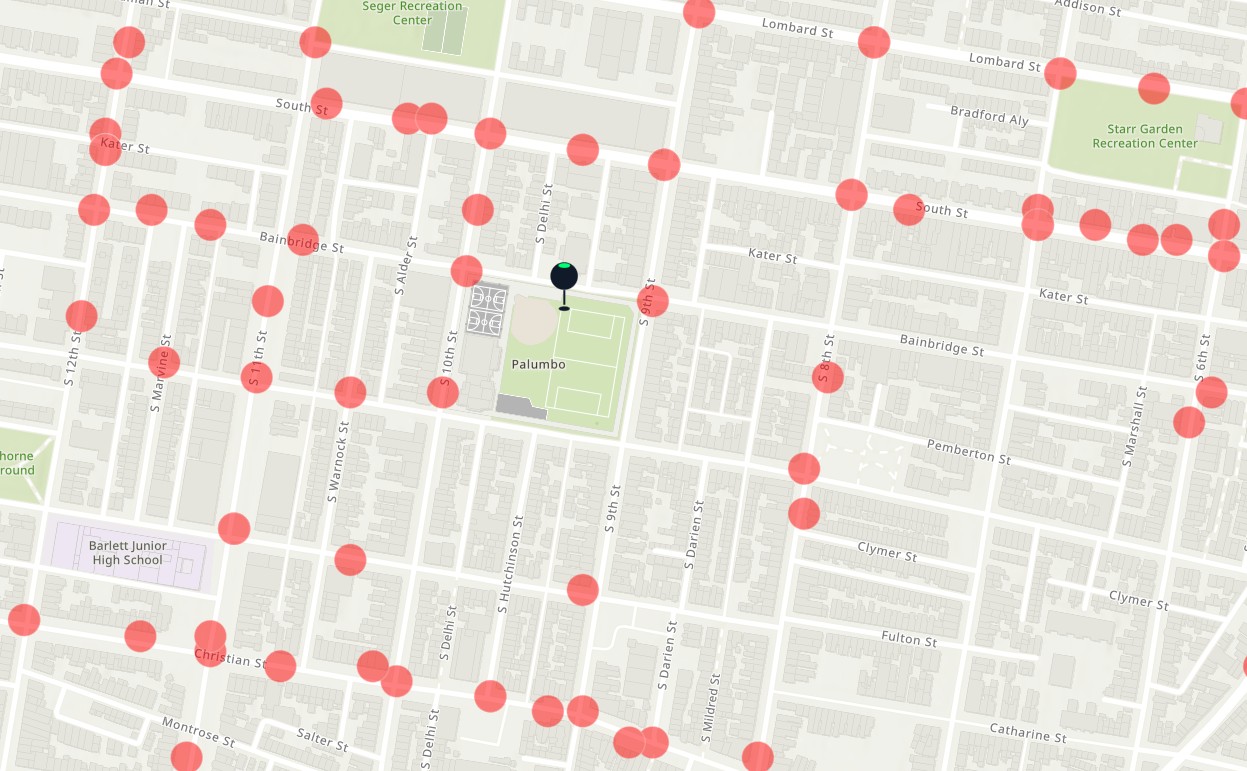
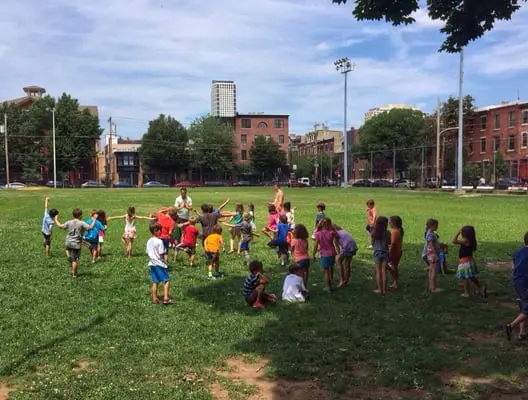
That setup means that streets designed in the 1700s for horse and buggy now have trucks of unusual size making their way across the city stop sign by stop sign, past houses, offices, and schools alike. At one such spot, the Palumbo Recreation Center, crossing the street often feels like you’re putting your life in the hands of the "chaotic gods" of Philadelphia traffic.
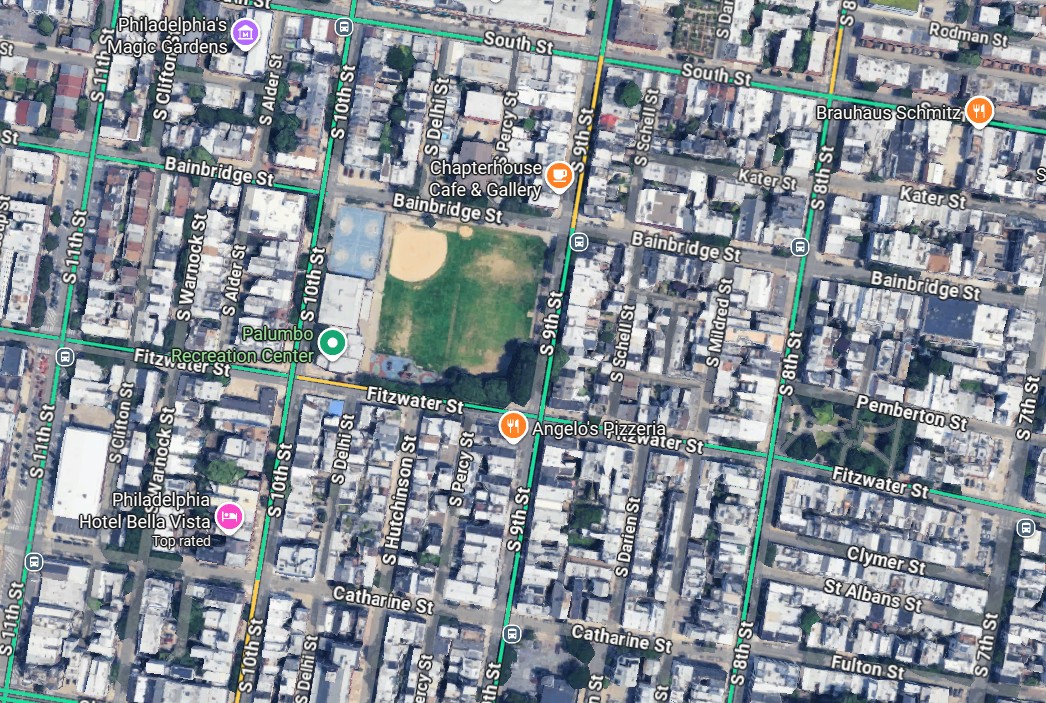
On paper, these are neighborhood streets. In practice, they form a gauntlet where families trying to get home safely are contending with out-of-towners on a trip to the famed Angelo’s Pizza, commuters rushing to the bridge, and drivers taking high-stakes risks in places that were never designed to accommodate speed or volume.
For those of us who live here, the danger is felt in your gut every time a car clips a corner or rolls through a stop sign. But for folks looking in from the outside, it’s worth describing the scene: it’s a place where drivers, frustrated by every stop sign and person crossing, try to get to the next intersection fast, while families peek out from behind cars parked on the crosswalk, trying to pick the safest moment to step out.
The city’s response: “we might get sued”
When I raised these concerns with my Councilmember and the Streets Department, I proposed a modest intervention: diverting through-traffic using planters. Residents would still be able to access their streets, but cut-though traffic would be routed away from the playground. Here’s how I framed it:
“My objective is to implement modality filtering using planters to deter thru-traffic. This approach would require vehicles attempting to drive straight through the area to make two turns, effectively limiting these sections to local traffic only.”
To his credit, the Councilmember responded quickly. He looped in the City’s Chief Traffic Engineer—for better or worse, our CTE has been in the trenches for a stretch of 30+ years that has seen some pretty discouraging crash statistics. His response, while disappointing, revealed a deeper, more systemic issue at play: the fear of being sued.
“Diverters, chicanes etc. using bike corals, flex posts, planters etc. are expensive, difficult to procure, & way too expensive to maintain. Plus, the City is self insured & having testified on thousands of cases against the city, it’s hard to defend. Folks sue us for many reasons that still surprise me. Law Department’s Risk Management unit will certainly be concerned.”
There’s a cautionary tale that helps explain why this fear looms so large for traffic departments across the country. In a high-profile Georgia case, there was a tragic single-vehicle crash involving a planter several feet off the roadway. The driver did not survive, and his parents filed a lawsuit against the city. In the end, the municipality was hit with a $32 million jury award—roughly 85% of that city’s entire annual budget—after the court determined that the planter constituted a defect in the right-of-way, rendering the city liable.
The ultimate irony? The city didn’t even install the planter; it was already there when the town incorporated.
Frustrating as it is, “folks sue us” is a powerful moment of honesty here. It reveals how city engineers and planners are constrained by the threat of litigation. If objects outside the roadway put cities at risk, how can they hope to implement even small, targeted interventions that could save lives?
Engineers themselves are particularly exposed. Their professional licensure, reputations, and institutional memory all reinforce a preference for designs that have already been used and successfully defended in court. Innovation isn’t just technically risky—it’s legally uncertain.
The result is a system that often prioritizes what is easiest to justify in court over what might best address a specific safety problem. Known dangers persist because they are familiar, while modest, context-specific changes face outsized scrutiny. As a result, we appear to sacrifice physical safety to protect the city’s legal liability.
That is painful enough to hear for folks taking a gamble crossing these streets every day, but it is excruciating for anyone who was unlucky enough to know someone, or be someone, that lost that gamble.
Budgets: rhetoric vs. reality
When faced with the liability issue, I pivoted and asked if we could implement raised crosswalks instead. The reply? “Limited funding.”
“Raised crosswalks & intersections, not only are super expensive to install, but in our city they pose tremendous challenges in grades & drainage... Our funding for schools’ traffic calming initiative is quite limited.”
And money is a real constraint! Especially because engineers and departments are not the ones that get to set the budget. That authority lies with City Council and the Mayor. But that’s where the disconnect becomes more apparent.
Philadelphia has publicly committed to "Vision Zero"—the goal of eliminating all traffic fatalities and severe injuries. Yet, there is a painful gap between the rhetoric of mourning preventable deaths and the reality of funding the tools to stop them. We see "larger-than-life" infrastructure projects receive millions or billions in funding, while modest, low-cost safety upgrades are treated as an "inconvenience" or a budgetary impossibility.
When the city treats a primary risk to neighborhood safety as a secondary budgetary concern, it signals that Vision Zero is a slogan, not an operational priority.
What’s more expensive in the end?
Ultimately, I told the city this directly: “Dead and injured Philadelphians are exponentially more expensive.” Lawsuits are cheap in comparison.
If we’re being cynical, a wrongful death lawsuit costs the city way more than a raised intersection. If we’re acting in good faith, measuring a child’s life against the cost of asphalt is absurd.
We need to stop accepting “it’s too expensive” as the default response to neighborhood safety concerns. We need to stop letting the Risk Management department design our streets. Put bluntly, until we value a kid on a bike more than a potential lawsuit from a driver, I can't help but feel like we’re just spinning our wheels.
At the end of the day, this isn’t an abstract policy debate. It’s about a specific corner, next to a playground, where families cross the street every day knowing the odds aren’t in their favor. Those families don’t experience our street network as a liability matrix or a budget spreadsheet. They experience it as a moment of risk—one they didn’t choose and can’t opt out of.
If our systems can’t respond to that reality with anything more than “it’s too expensive” or “we might get sued,” then the problem isn’t a lack of money or engineering expertise. It’s a failure to treat neighborhood safety as a core responsibility of local government.
I wince at the sound of the salt trucks leaving the township yard up the street from my home. Whenever winter weather arrives, whether it be a foot of snow, an ice storm, or a dusting of dry powder, I hear them whine and rattle down the hill to the stop sign. The harm caused by road salt is well-documented, and through my avocation in ecological restoration I’ve seen its effects firsthand—eroded stream banks and depauperate stream life.
A couple weeks before Christmas, after driving my family over a few miles of roads white with salt spread for a dusting of overnight—snow that had melted in my untreated driveway by 10:00 a.m.—I reached out to some local elected officials who have graciously listened to my concerns. Naturally, the safety of roadway users has been an important topic.
As part of this outreach, I examined statistics produced by the Pennsylvania Department of Transportation (PennDOT) for my home region of Montgomery County, Pennsylvania, a suburban county northwest of Philadelphia with a population of over 850,000.
The following numbers reflect accidents for which police reports were filed between January 1, 2019 and December 31, 2024 where the report identified snowy, icy, or slushy [hereinafter referred to as “slick”] conditions on the road surface at the time of the accident, and the most serious level of injury that occurred:
- Fatal injury: 2 (0.15% of all accidents)
- Serious injury: 10 (0.77% of all accidents)
- Minor injury: 339 (25.98% of all accidents)
- No injury: 946 (72.49% of all accidents)
- Unknown: 8 (0.61% of all accidents)
This table shows the same statistics except in non-slick conditions (dry or wet but unfrozen):
- Fatal injury: 227 (0.50% of all accidents)
- Serious injury: 1199 (2.62% of all accidents)
- Minor injury: 19143 (41.85% of all accidents)
- No injury: (23801) 52.03% of all accidents
- Unknown: 1372 (3.00% of all accidents)
Drivers in northern and mountainous regions are all taught how dangerous slick roads are, how careful we must be, how patient, how slow, how to tip-toe toward stop signs so we don’t slide through. It appears those lessons are well learned. To my surprise, accidents on slick surfaces that are fatal or result in serious injury only occur one-third as often as accidents in ordinary dry or wet conditions. In other words, 0.92% of crashes in slick conditions produce a fatal or serious injury, compared with 3.1% of crashes in non-slick conditions. Over 70% of crashes in slick conditions produced no recordable injury at all.
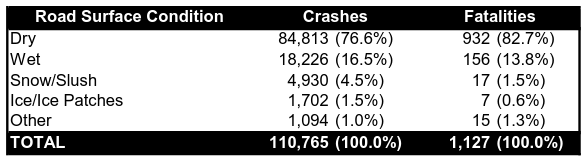
I thought I must have made a mistake, but PennDOT’s own 2024 Pennsylvania Crash Facts and Statistics seems to bear this out on a statewide level (see page 14): 76.6% of crashes occur in dry conditions, resulting in 82.7% of recorded fatalities, while 6% of crashes occur in slick conditions and only account for 2.1% of recorded fatalities—again, roughly one-third the fatality rate of non-slick conditions:
Perversely, aggressive winter road treatments with salt—beyond their documented harm to the environment, infrastructure of all kinds, and human health—also appear to make us less safe by converting icy conditions into wet ones. Not because of the treatment itself but, I believe, because it diminishes the natural traffic-calming effect of snow and ice. It shifts us from cautious drivers in slick conditions—who simply cannot drive too fast for those conditions—back into ordinary drivers on over-designed roads.
Chuck Marohn of Strong Towns has previously written about the increase in traffic injuries and fatalities that occurred during the COVID-19 pandemic, and how the actual cause of increased danger was reduced congestion and therefore greater freedom to drive at unsafe speeds on roads that were designed to prioritize speed over safety. I believe these statistics about winter driving reflect the same phenomenon. As with crashes in congested traffic, winter weather crashes, while possibly more frequent, tend to occur at slower speeds and are correspondingly less deadly.
Winter weather causes all of us to drive carefully and patiently, alert for the unexpected. It reduces the illusory margin of safety provided by wide lanes and excessive shoulders. Just as snow throws leafless trees into stark relief against a background of white, so it also exposes the dangers of conventional roadway design.
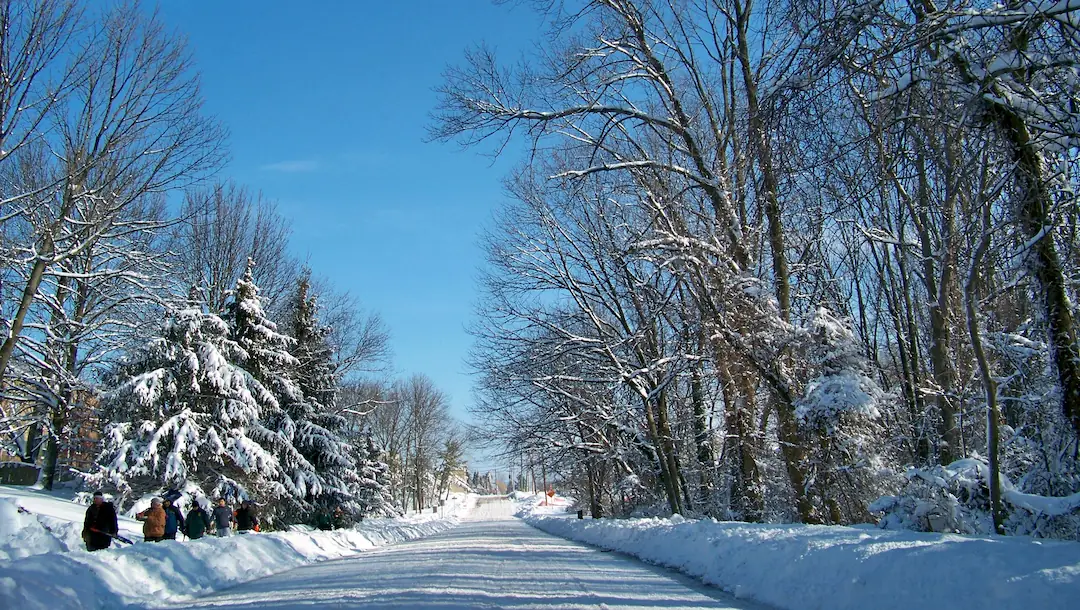
Editor’s Note: This piece comes from a Strong Towns Local Conversation member observing how winter snow reveals the underlying priorities of our streets. The goal is not to prescribe a universal fix, but to encourage locally grounded reflection on how street design affects mobility and access year-round.
[[divider]]
Every winter, the same pattern appears. Snow falls, plows roll out, and crews work continuously until roads are mostly clear. Cars continue to move with minimal interruption.
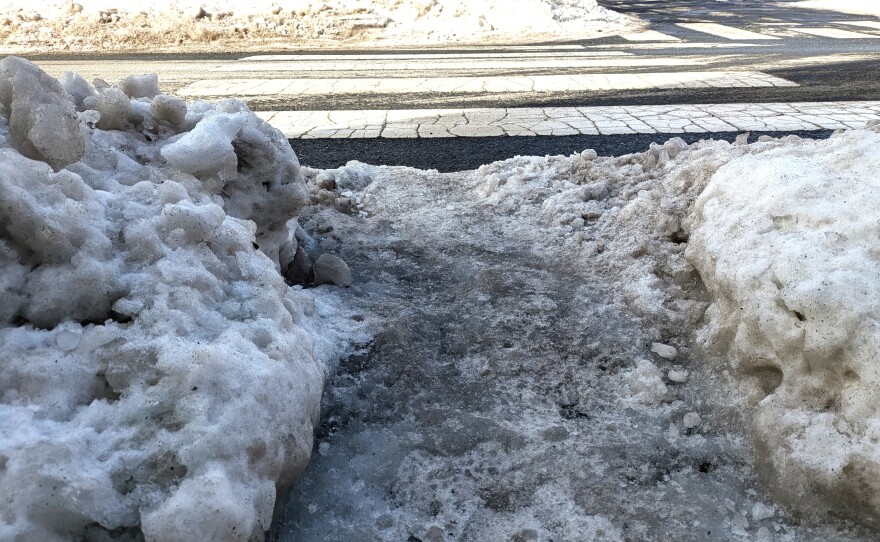
At the same time, sidewalks disappear for long stretches. Crosswalks end abruptly as snowbanks pile up. Curb ramps—the places where people are meant to cross—become blocked or unusable. For many residents, this isn’t just an inconvenience; it’s an accessibility nightmare. People using wheelchairs, walkers, or strollers can find entire routes suddenly impassable because the infrastructure they rely on is treated as secondary.
This isn’t a failure of effort or goodwill. It’s not about who did or didn’t shovel. Winter simply reveals what our public right-of-way is designed to prioritize
Snow is a roadway audit, if you know where to look.
Roads Are Treated as Essential Infrastructure. Sidewalks Are Treated as Optional Space.
When snow falls, roads are cleared first, fastest, and most thoroughly. This makes sense within the logic of the system: roads are wide, continuous surfaces designed to be serviced by large equipment.
Sidewalks, by contrast, are narrow, fragmented, and often physically separated from the roadway. Even where they are publicly owned, they rely on different tools, different timelines, and sometimes different responsibilities. The result is predictable: sidewalks remain icy, narrowed, or blocked long after roads are fully passable.
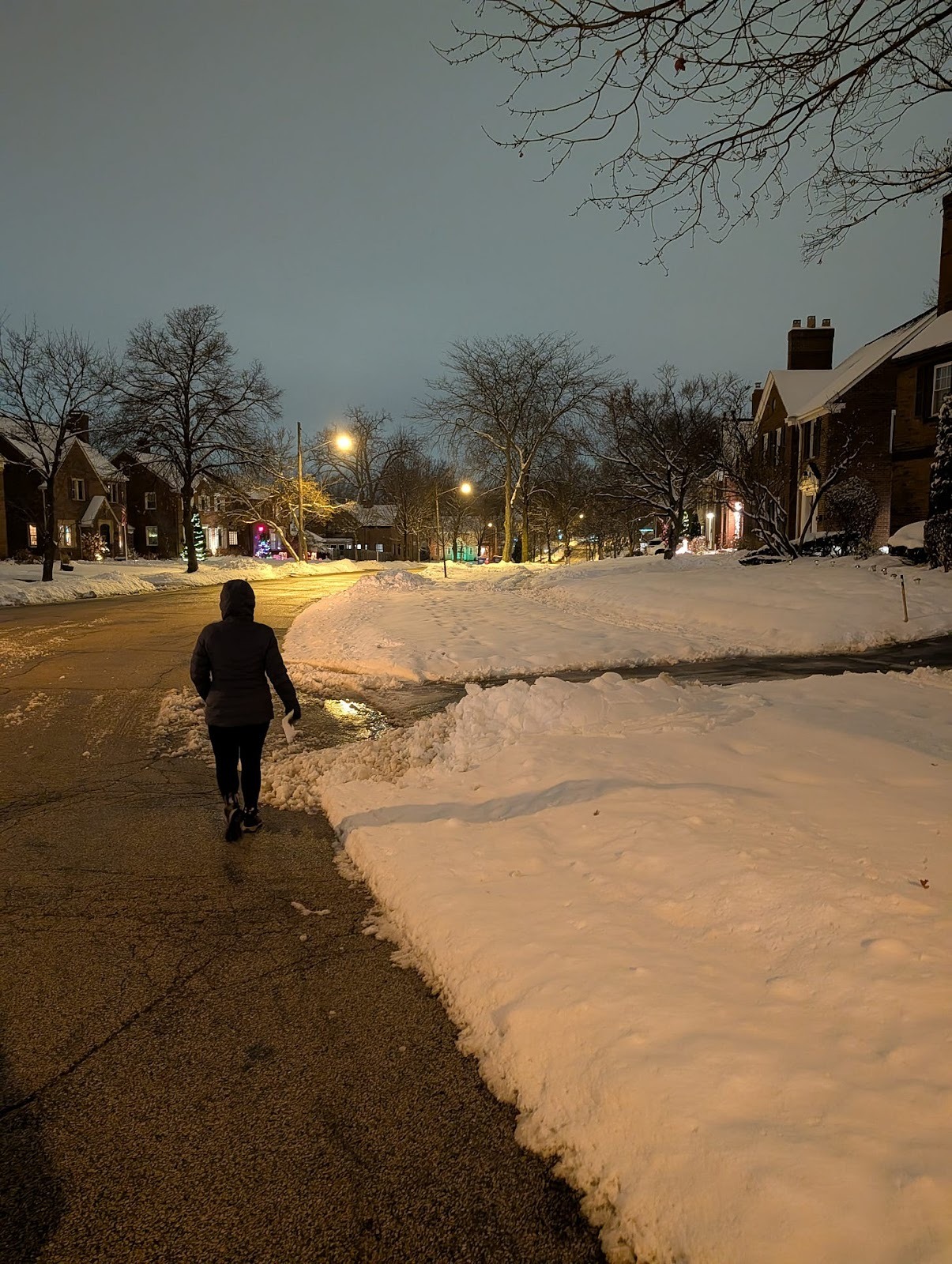
What winter exposes is not neglect, but design intent. Roads are built to function year-round. Sidewalks are treated as “nice to have” left-over space once vehicle movement has been accommodated.
Intersections Tell the Most Honest Story
If you want to understand a street’s priorities, look at its intersections after a snowfall.
Pedestrians are forced to step into the roadway or detour away from the place where crossing is intended to happen because once the snow is off the roadway the job is “done”. People on foot are expected to navigate slush, ice, and piled snow at precisely the point of highest conflict.
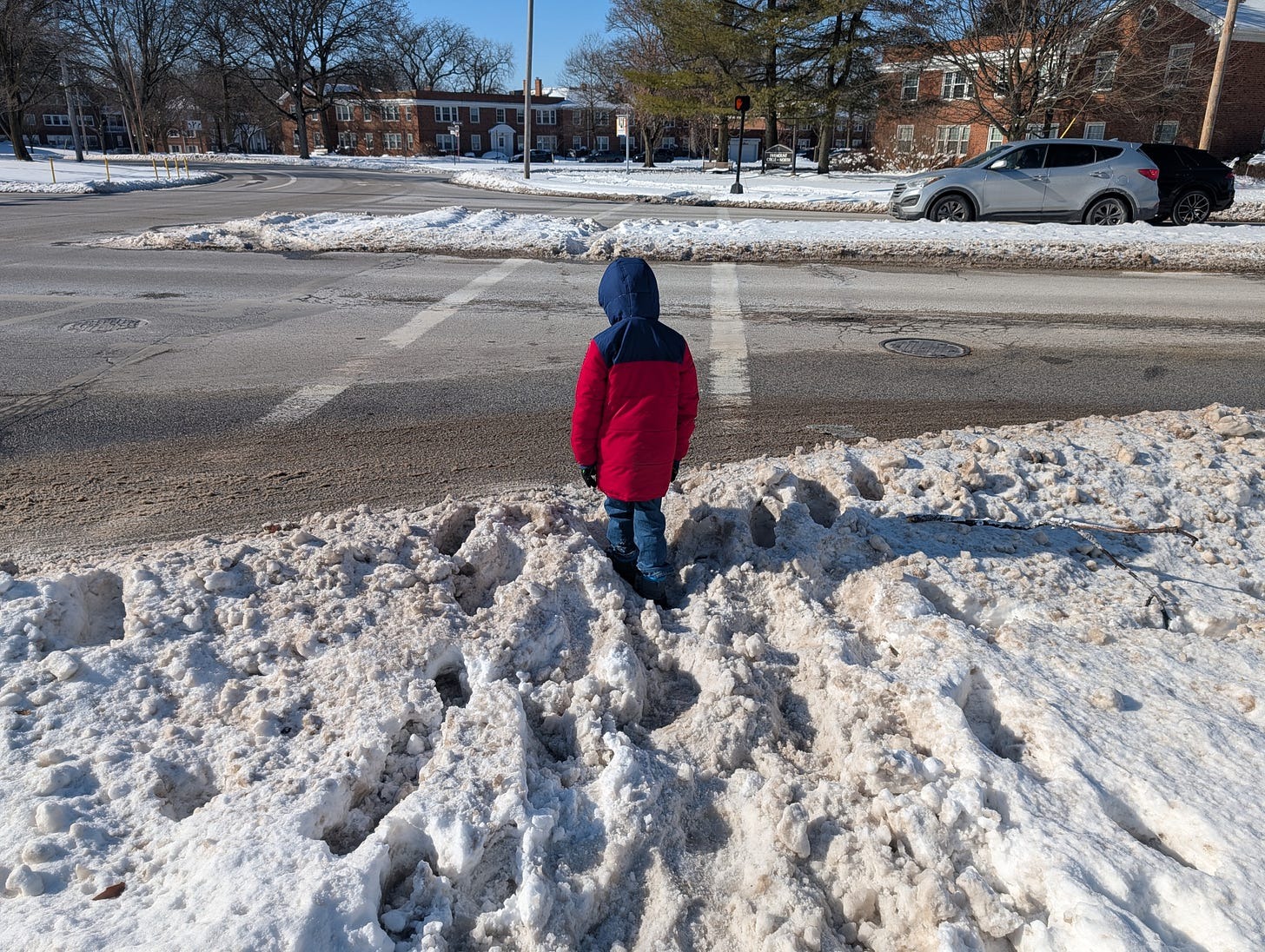
None of this is accidental. Intersections are engineered first for vehicle movement and storage, with pedestrian crossings frequently constrained by what space remains. Winter strips away the appearance that all users are being accommodated equally.
On the other hand, one of winter’s lessons is just how adaptable vehicle movement is, even when streets are narrowed by snow. After a storm, lanes are often functionally slimmer. Shoulders disappear. Parking lanes vanish. And yet traffic continues to flow. Speeds adjust. Drivers, of course, adapt.
The extra asphalt that vehicles barely use in winter still dictates how far a person must walk across moving traffic in the summer. Crossing Warrensville Center Road at Fairmount Circle, for example, is a daunting 105 feet from curb to curb on a normal day! On a snowy day, that distance is reduced to less than 80 feet with a brand-new visual “refuge area” thanks to unplowed snow.
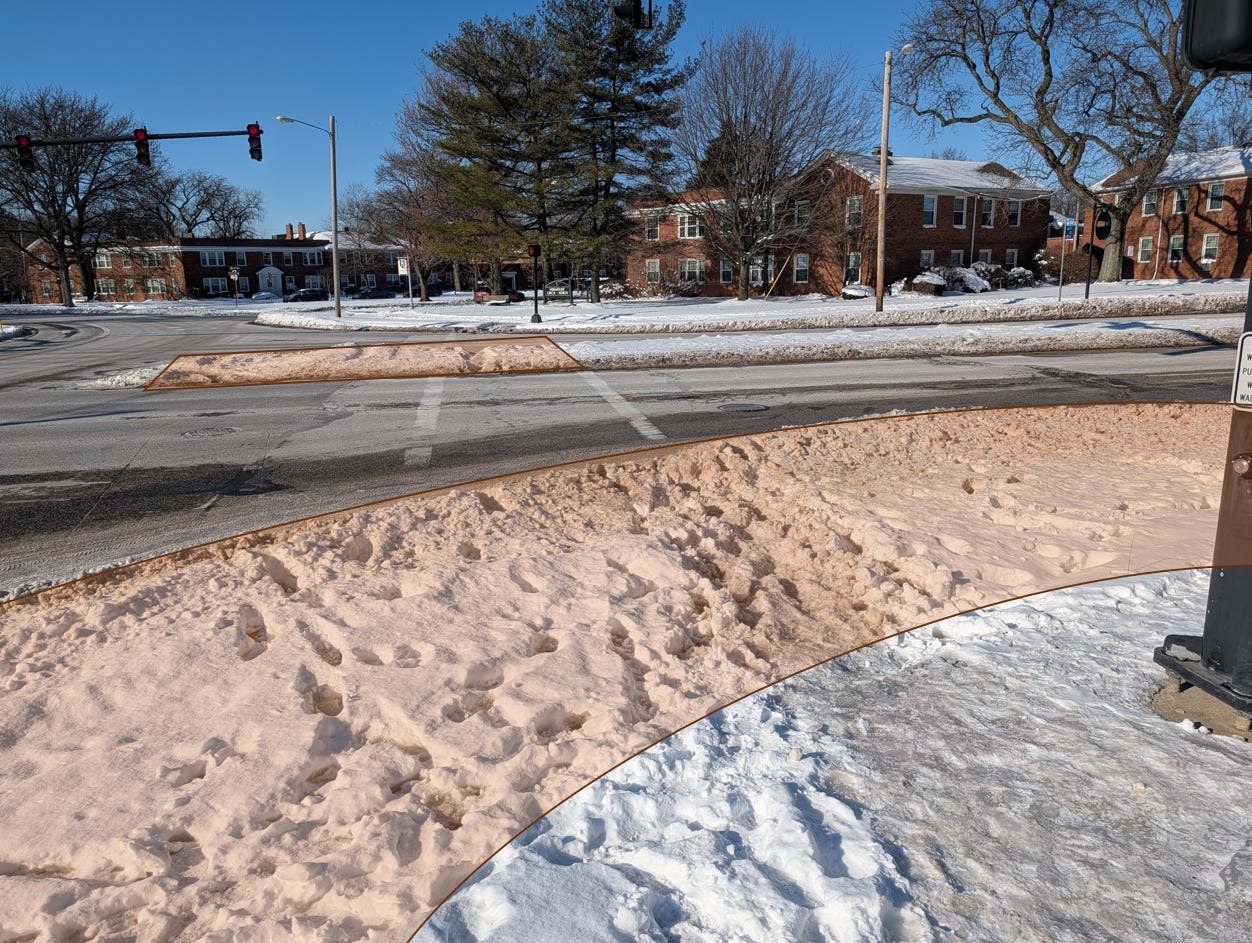
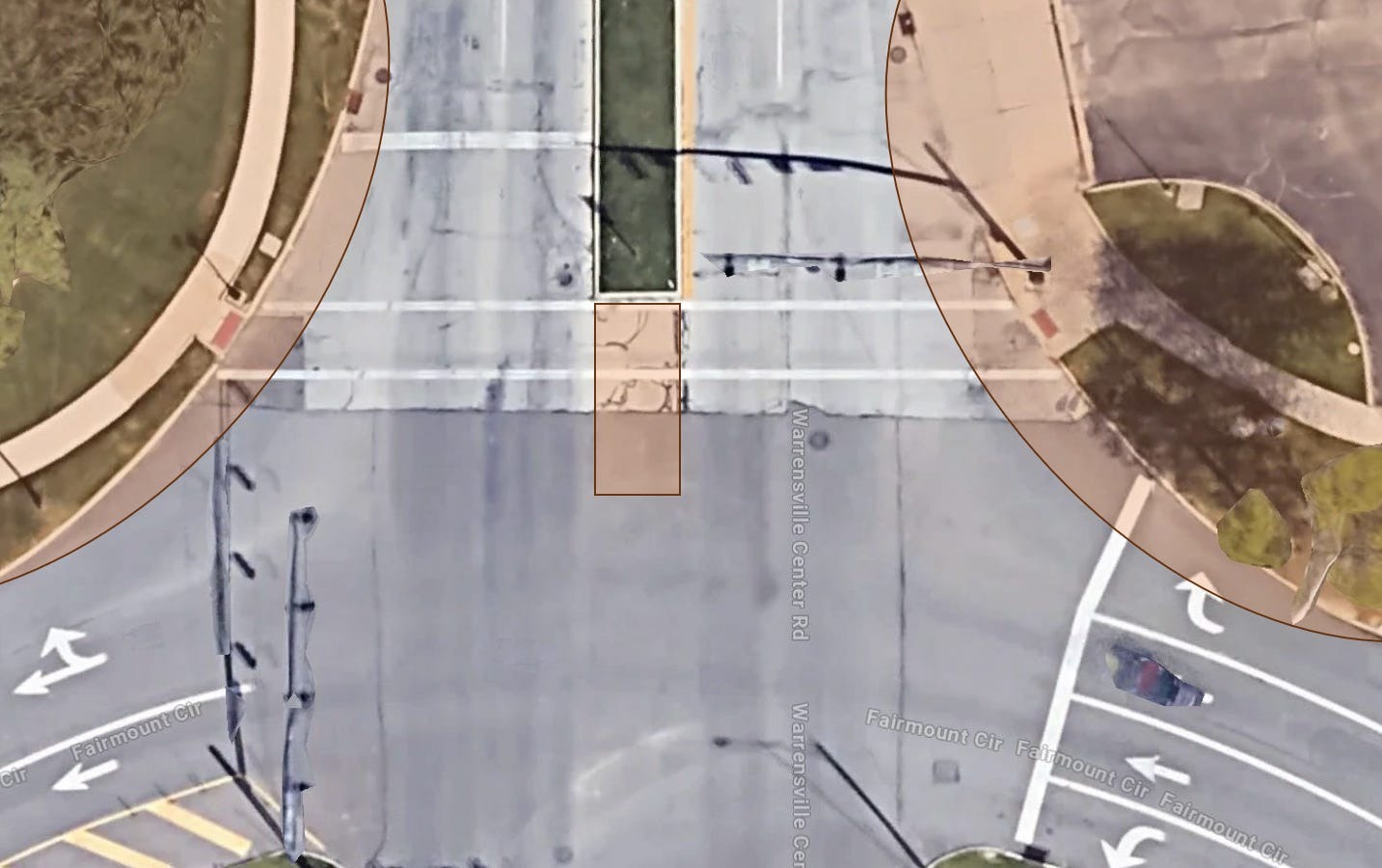
Winter unintentionally performs a kind of "road diet" and traffic survives it just fine. The fact that streets continue to function with less exposed pavement raises an uncomfortable question: why do we need so much of it the rest of the year?
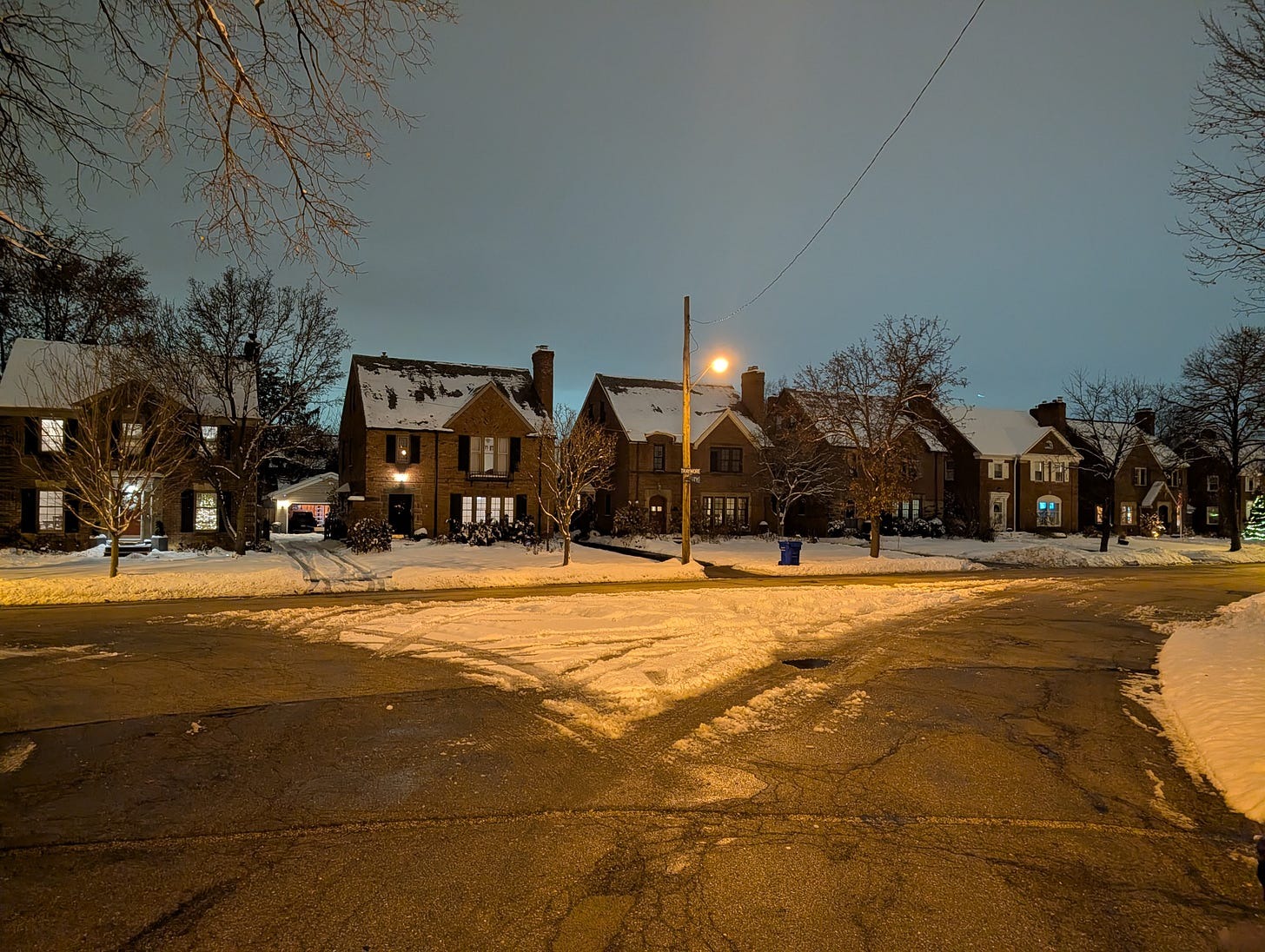
What Winter Makes Impossible to Ignore
When the snow melts, these imbalances fade from view. Sidewalks widen again. Crosswalks reappear. The street looks neutral, even fair. But winter tells us several truths.
It shows us that our streets are not neutral spaces shared equally by all users. They are shaped by a set of design assumptions: that speed matters more than safety, that vehicle movement must be effortless in all conditions, and that walking can adapt around whatever space remains.
But it also reveals something hopeful alongside this imbalance. Vehicle travel continues even when lanes are narrowed, speeds are moderated, and excess pavement disappears beneath drifts.
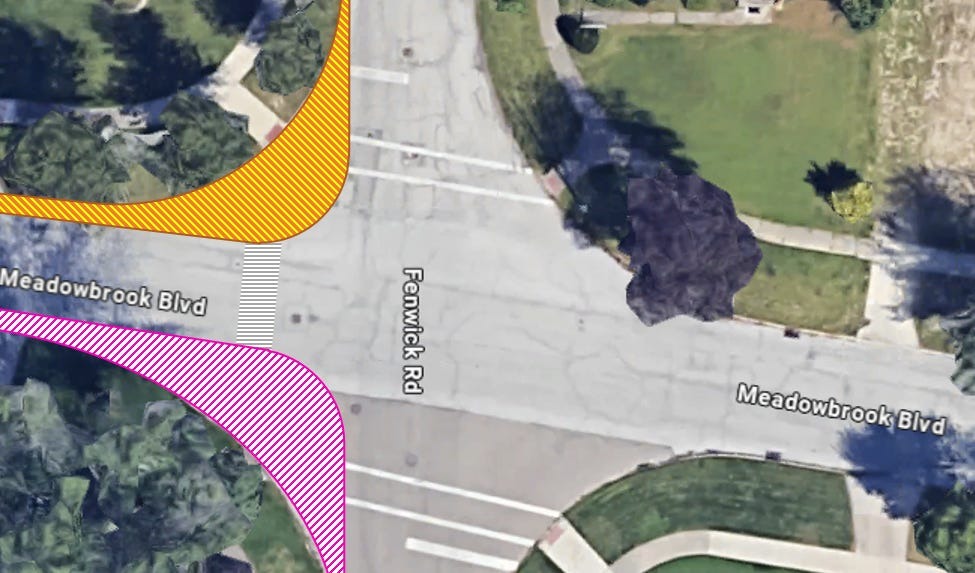
This contrast is a place of opportunity. If we want streets that work year-round, for everyone who uses them, we can design them that way from the start. Not just by hoping for the best, but by learning from what winter “snows” us.
.webp)
Across public squares all over Europe, early evenings fill with the sound of children racing across cobblestones, inventing games beneath café umbrellas, and darting between benches. Nearby, parents linger over coffees, glasses of wine, or leisurely dinners, half-watching, half-unwinding as the life of the square hums around them. It’s a familiar scene: the family outing, where kids get to play, explore, and simply be kids, while their parents finally get to relax.
Meanwhile, in Langley, parents can never quite exhale. They’re scanning for cars, checking blind spots, tracking every passing pickup, hovering at the edges of parking lots as if standing guard. Every time their child drifts more than fifteen feet away, a new calculation is made in an endless loop of vigilance that turns even a simple outing into a low-grade emergency.
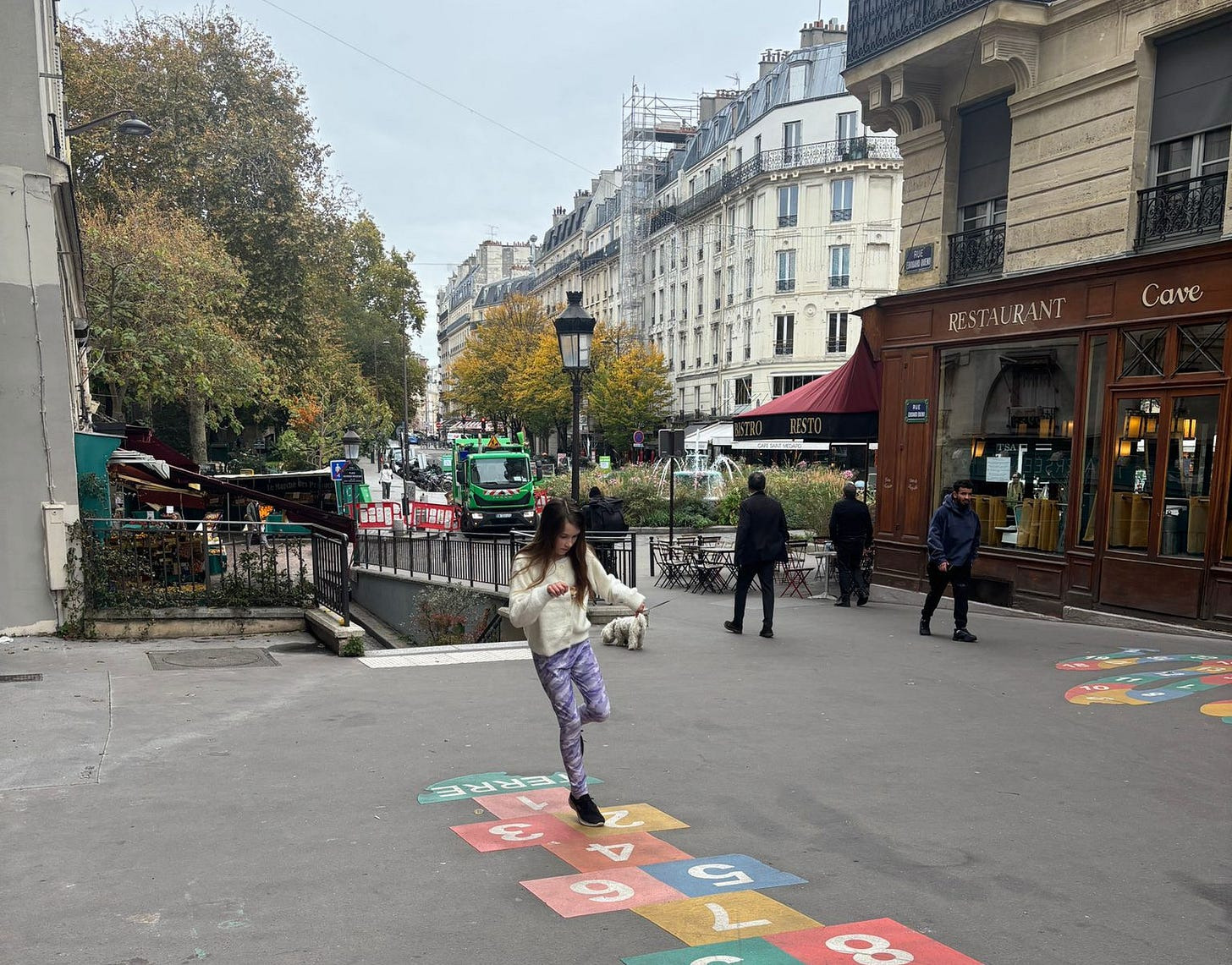
This isn’t overprotective or “helicopter” parenting, it’s what our built environment demands from parents. While a public square helps add to children’s safety in Europe, our cafe patios all exist either inside parking lots or on the edge of busy roads. Langley doesn’t have many places where kids can be kids and parents can just… let them.
We’re Investing in Game Day but Ignoring Tuesday
The Township of Langley is spending big on youth facilities right now. The Smith Soccer Academy: $130 million ($CAD). The 5-Rinks ice complex: another $150 million. These are state-of-the-art facilities, among the best-designed of their kind.
I asked a local councillor a straightforward question about why 5 Rinks was prioritized when families in the Willoughby neighbourhood, for example, would benefit more from a library or community center. His answer reflected a broader assumption baked into municipal decision making. It focused on the design quality, construction cost savings from starting early, the efficiency of underground parking and stacking dry floors above ice sheets.
He said this approach was “what is needed to deal with such a large youth population” and that these rinks “will serve many needs not just hockey.”
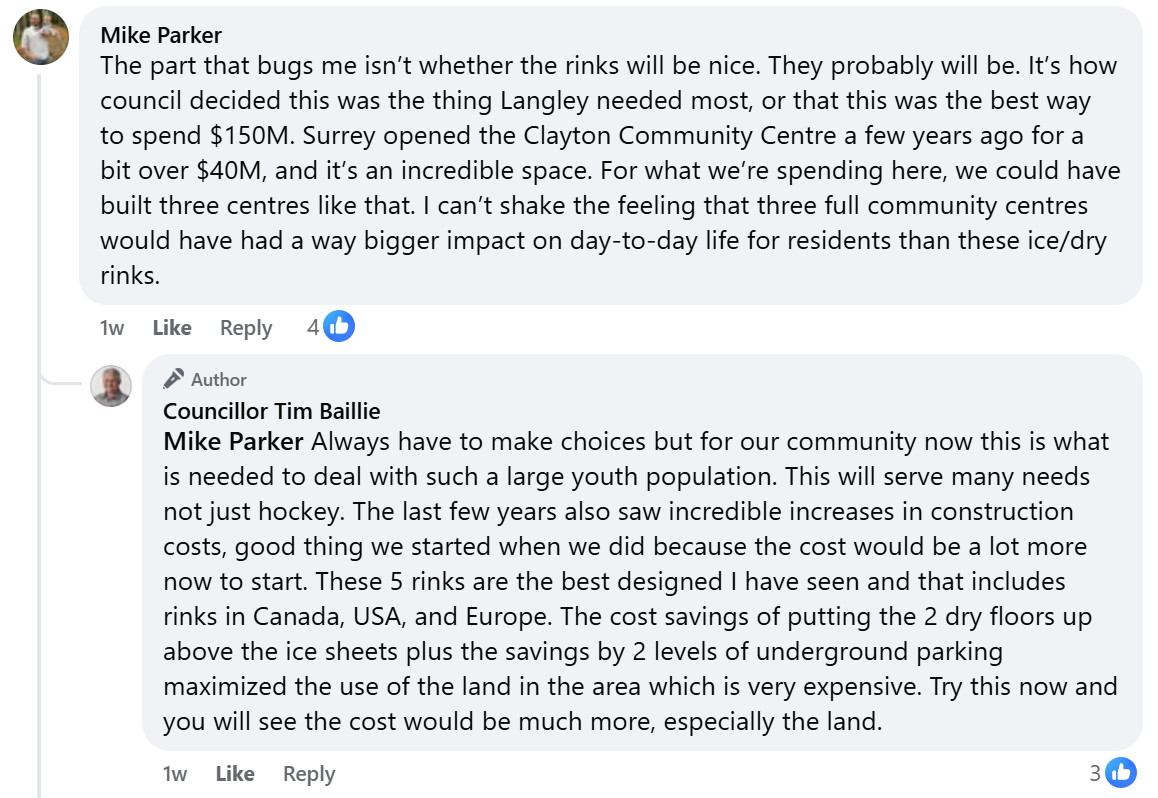
He’s not wrong about any of that. The facilities will be well-designed. They’ll serve lots of kids. But notice what’s missing from that answer: any acknowledgment of what daily family life actually feels like in Langley.
On a random Tuesday afternoon, where can I take my kid so he can run around while I sit down for 20 minutes without being in constant surveillance mode? Where in Langley can we go that doesn’t require me to scan for backing-up cars?
The Smith Soccer Academy and 5-Rinks will give us a few hours a week of scheduled, structured activity that requires driving to a centralized location. What they won’t give us is any relief from the other 160 hours of the week when we’re just trying to get through the day.
That disconnect between massive investment in youth sports infrastructure and zero investment in reducing daily parenting stress explains everything about why raising kids in Langley feels so exhausting.
The Shape of Daily Life Here
Think about the daily life of a Willoughby family, the places they go and what those places look like. The grocery store, a cafe, a restaurant, day care pickup, schools. All these places are on a sea of asphalt designed for optimal car throughput and abundant parking.
In these environments, children can’t roam even a little. Cars are everywhere moving fast and built on a scale that hides children completely. Parents are constantly on edge because the built environment prioritizes cars over the safety of our children.
Even in places meant to be walkable—like the still developing commercial town centre—there are no real barriers between kids and traffic. Drivers pull in and out of busy entrances without expecting children. Patios are hemmed in by parking stalls, and there’s nowhere small, safe, and interesting for kids to wander, explore and play.
A Very Specific Example of a Good Place in Langley
On the next nice day go have a beer at Locality Brewing (a local brewery in rural Langley) and see what happens with the space they’ve created there. Parents sit at picnic tables having a beer while their kids run around the open area, running in circles, kicking a ball, playing on the slide, checking out the lagoon. No one is tense. No one is scanning for backing up SUVs. The environment does the hard work, not the parents.
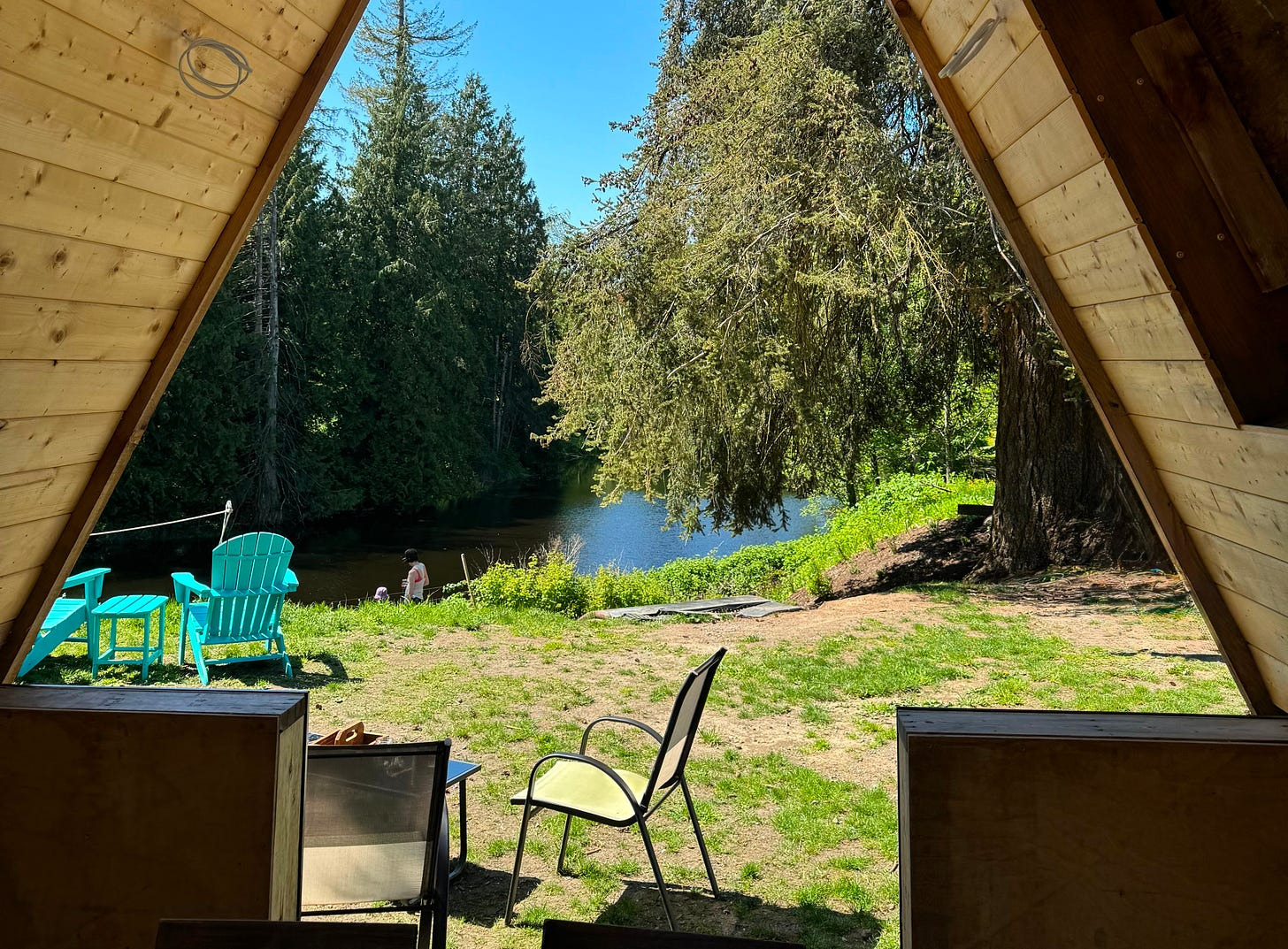
This space works not because they spent hundreds of millions on designing it but because it’s one of the only places in Langley where parents aren’t forced into a hyper alert mode and can instead just enjoy themselves. It’s a reminder that kids don’t need arenas to have fun, grow and develop. They need safe spaces scaled to their bodies and abilities. Parents don’t need more spaces for structured play, they need a break. Places like this should be everywhere.
Latimer Village is a Near Miss that Explains Everything
Latimer Village is a new mixed used master planned community. It could have been Langley’s answer to the child-friendly European town square. The density is there, the retail shops are there even the branding of it being a village implies that we’re thinking about community but it still misses the mark.
The residential buildings have central green-space, but the mixed-use buildings with shops, the natural heart of community life where families and friends get together, have central parking lots instead. The pedestrian-only section that actually invites wandering, play and exploration is tucked in the back, invisible from patios and storefronts where the parents sit.
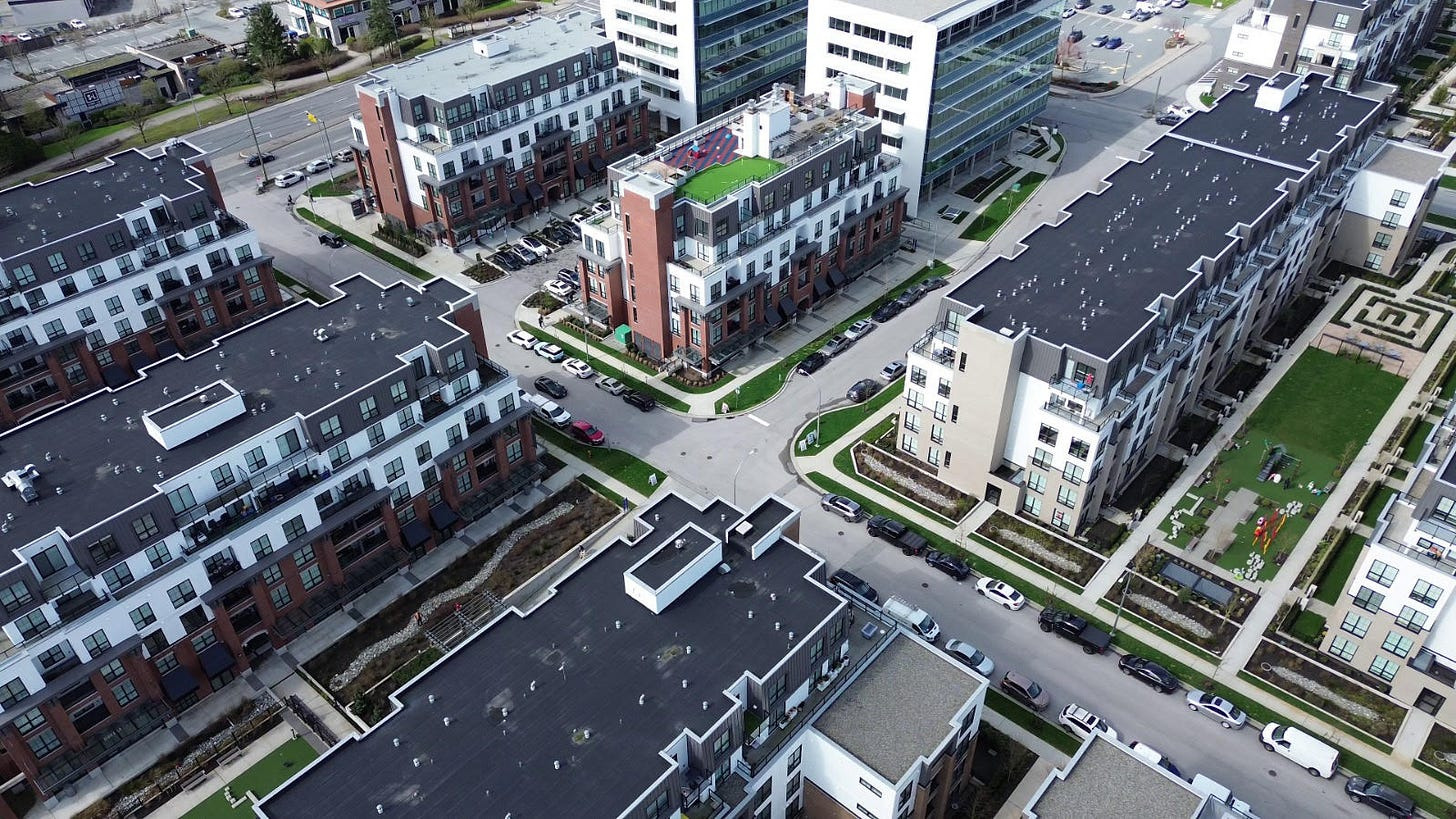
The message the development sends is clear: eyes up, stay close, watch for cars and definitely don’t relax. Latimer Village isn’t a failure of ambition, it’s a symptom of how we default to cars first, people second. Even our walkable village is shaped by car logic.
Imagine if, instead, Latimer Village’s shops fronted a public square and playground. You could sit on the cafe patio having a latte while your kid played. It would also create a more inviting destination overall where people can spend more time. Business owners are often concerned about parking, but they should also consider “stay-time.”
Beneficial relationships can start to form between different adjacent businesses. Someone may want to do some shopping, or get a haircut, and then because they are spending more time in the area, they end up also having a coffee or getting food afterwards. The more inviting and nice the area is to be in, the more likely they are to stay for longer, especially if there are things for kids to do. Even indoor shopping malls understand these benefits.
Sadly, we don’t get that reality. Instead, we built Latimer Village for cars first and yet people still complain constantly about parking there! So what did we achieve by giving all this up for store-front parking?
Mega-Projects Aren’t the Answer
The Smith Academy and 5-Rinks aren’t bad facilities. They’ll be beautiful. Kids will learn teamwork and sportsmanship. Tournaments will come to town.
But they require families to:
- Drive long distances to and from centralized locations
- Navigate congested parking lots with one or more children
- Register and pay for a scheduled and structured activity
This is the exact pattern that makes parenting in Langley so stressful, and we just spent $280 million reinforcing it.
We have built a system where youth recreation is highly structured, highly scheduled and car dependent while unstructured daily childhood play has nowhere to exist. Instead of building everything in two massive complexes, these projects could have been spread throughout the community. These could be smaller facilities families could walk or bike to for a game, with the remaining budget invested in the neighbourhood spaces where daily life actually happens.
The Opportunity Cost
It’s not just the $280 million. It’s the opportunity cost of what we didn’t build. For the price of 5-Rinks alone, we could have built three community centres like Surrey (our neighboring municipality) spread across different neighborhoods. Each would be walkable for thousands of families. We’d still have tens of millions left over for:
- Plazas with car-free edges where kids can roam
- Neighbourhood parks within a 10-minute walk of every home
- Traffic-calmed streets that kids can ride bikes and play street hockey safely on
- Patios that face play areas instead of exhaust-filled parking lots
These things don’t cost hundreds of millions but we’re not building them because we spent that money centralizing sports instead of distributing access to safe, unstructured play space.
Worse these developments create a negative feedback loop:
- Mega projects force parents to drive further
- We spend more on parking lots and roads
- More car infrastructure leads to less safe neighbourhoods
- Less safe place creates more demand for centralized mega projects
- More centralized projects leads to more driving
We’re not only missing an opportunity, we’re actively making it more difficult to solve the real problems Langley families are facing.
A Town Built for Families
Langley is full of young families and school enrollment shows that we are only attracting more and more young families. We’ve built a landscape where raising kids requires constant vigilance.
We have a few small examples like Locality which offers space for parents to exhale and relax a little bit. Latimer Village shows how close we are to getting it right but these sports complexes show how much we’re still spending on the wrong problem.
If we want to support families, the simplest and most powerful thing we can do is build environments where kids can play and parents don’t have to hover.
A family friendly city isn’t one with the best soccer academy or the shiniest hockey rinks, it’s the one where parents can finish a cup of coffee while their kids play within sight. We had $280 million to invest in Langley’s children. Instead of investing in the everyday spaces that make daily life easier and more joyful, we went for the spectacle and in the process, left childhood and parents on the sidelines.
[[divider]]
This article was originally published, in slightly different form, on Strong Towns Langley's Substack. It is shared here with permission.
Strong Towns Langley is a community group dedicated to making Langley, British Columbia a better place. We advocate for incremental development, sustainable transportation solutions, housing accessibility, public spaces, and responsible growth strategies. Our group is part of the larger Strong Towns movement, focusing on creating financially resilient and people-oriented communities.
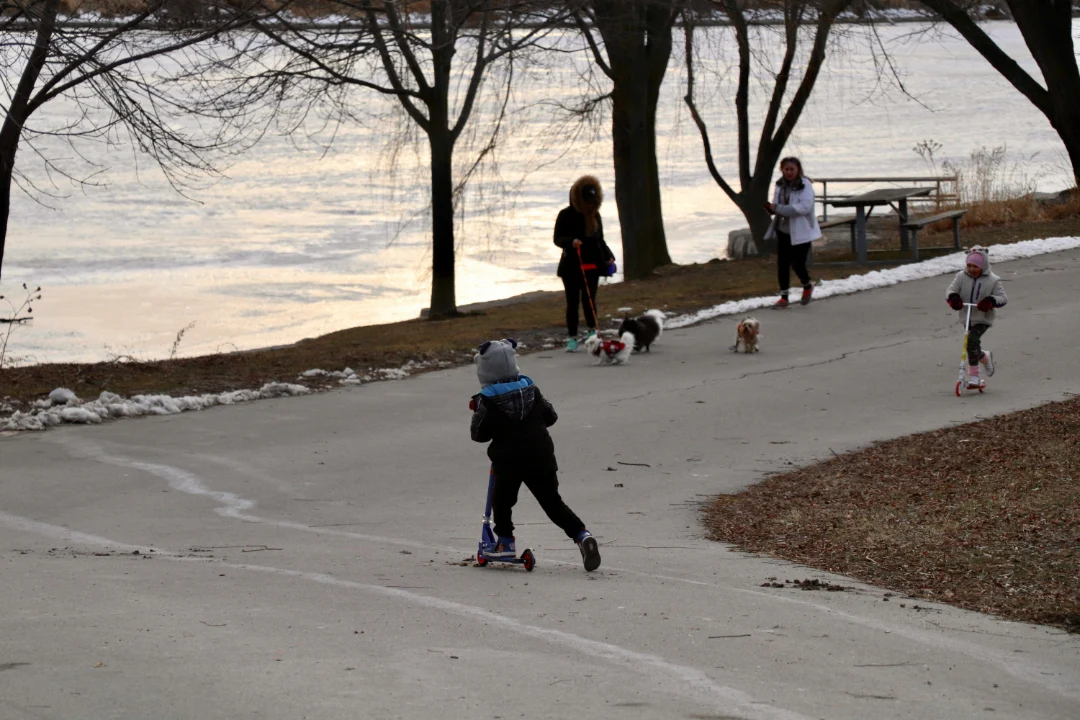
Caroline Tanbee Smith fell in love with New Haven, Connecticut the way a lot of people fall in love with a place: not all at once, and not because a brochure told her to.
It was the small things first. A run past the same porch, the same nod, the same wave. Summer days spent wandering “dusty corners” of City Hall for a project that forced her to learn the city as a living, somewhat messy, thing. And then the kinds of memories that you can’t plan for: sitting on the grass, surrounded by 8,000 people, all gathered to listen to cellist Yo-Yo Ma in the rain.
What all of these moments had in common was not spectacle, but proximity. They depended on people being able to see one another, linger together, and share space without rushing through it. In other words, they depended on the basic conditions that allow people to be neighbors.
Today, much of Tanbee Smith’s work focuses on restoring those conditions in a city where midcentury planning decisions took them away.
“My belief in New Haven is really derived by the spirit of advocacy, the history, the entrepreneurial spirit of the city that you can just feel rippling through the sidewalks and streets,” she recalled on the Bottom-Up Revolution podcast. “I think, as a young person at the time, I was so moved by that experience and also built so many friendships that made me say, ‘Hey, I want to fight for this place too,’ just like these mentors and coaches I see around me who are fighting for this city.”
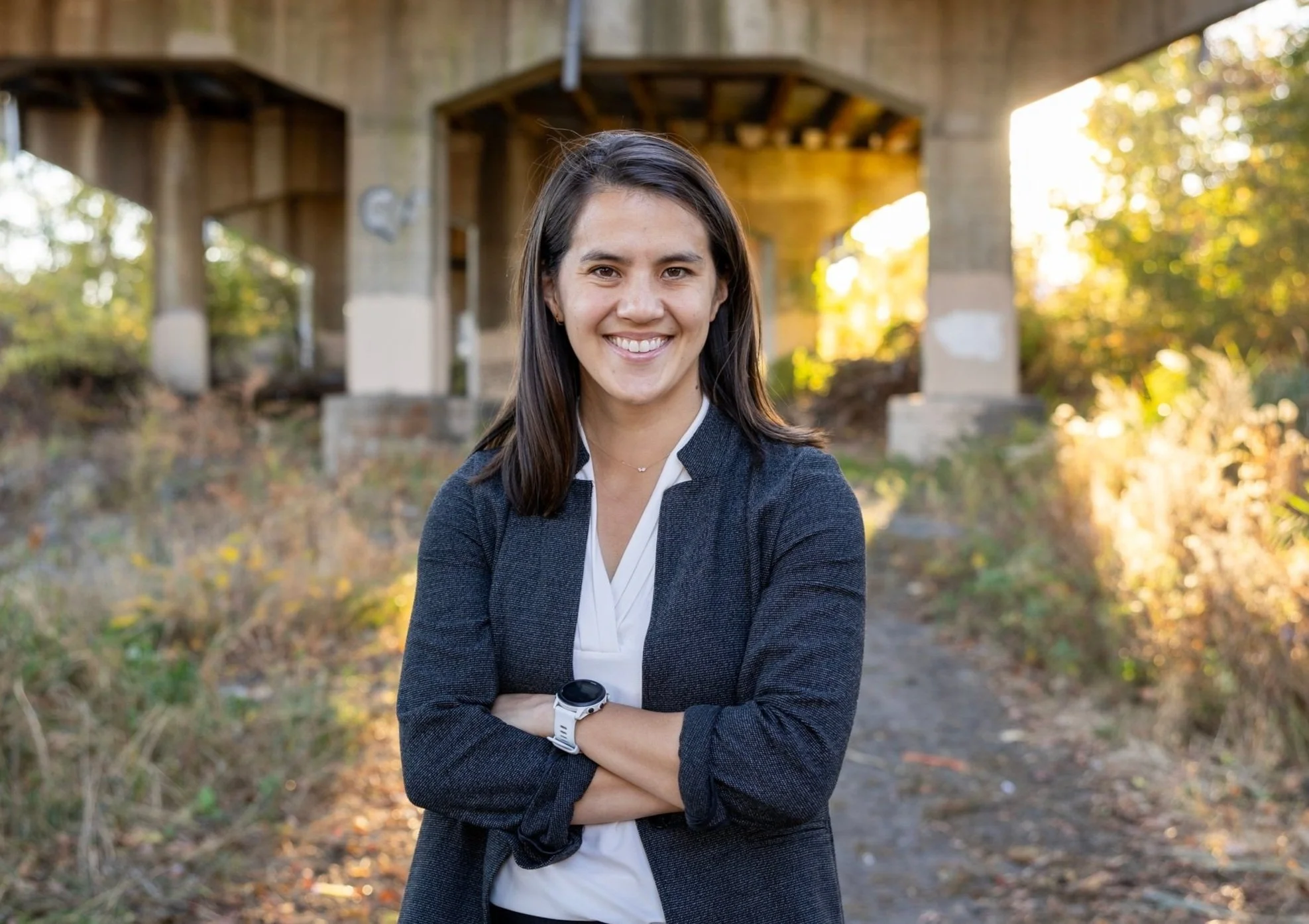
Now she’s an Alder in Ward 9.
In the mid-20th century, at the height of the urban renewal movement, New Haven received $120 million in federal funding to clear so-called urban blight and redevelop its aging industrial core. City leaders were told they were building the future, a blueprint for others to follow. What followed instead was a cautionary tale. The construction of I-91 tore through neighborhoods, destroyed thousands of homes, and accelerated the flight of residents to the suburbs, draining the local tax base. What was meant to modernize the city instead fractured it. The wounds sting over half a century later.
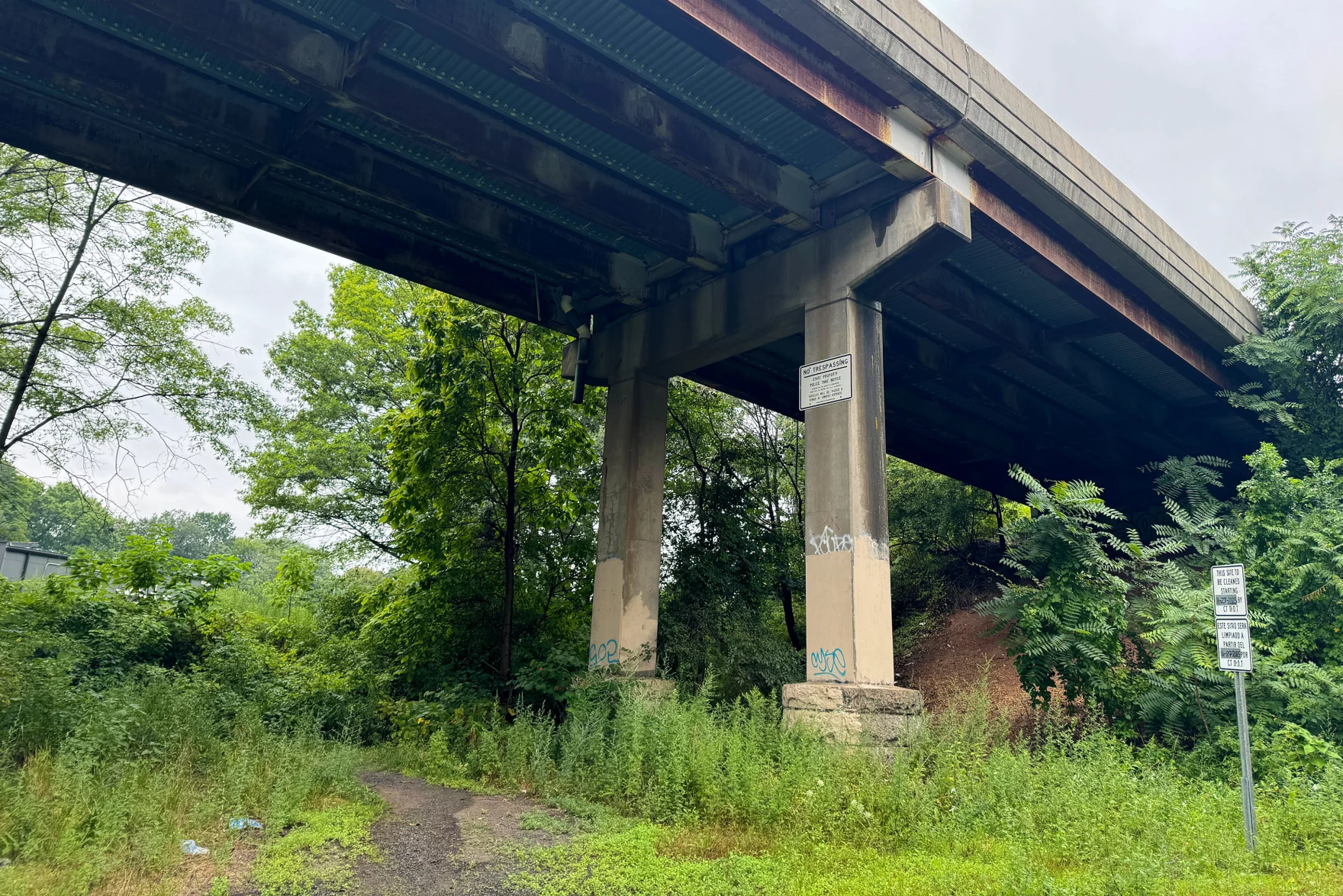
“You can really feel the divide,” Tanbee Smith told PBS last year, describing the separation between East Rock and Fair Haven. “So about a year ago, me and a few other people looked at this underpass and this space and started to say, ‘OK, well, what if we were to take this area and reimagine it into an area that connects them back together?’”
But Tanbee Smith doesn’t talk about the highway like a monument you mourn. She talks about it like a problem you can work on, patiently, publicly, and with the people who live in its shadow. That mindset helped drive the city to pursue a federal Reconnecting Communities grant and launch the I-91 Neighborhood Reconnection Initiative. Getting funding for a different future is key, but what’s equally important is the signal it sends: New Haven is a city willing to look at its own scar and say, out loud, we can do better than this.
One underpass in particular has become a kind of proving ground for that imagination. For years it was the kind of place cities ignore: leftover space, dim and unfriendly, often trashed, easy to forget unless you live nearby. Tanbee Smith and partners have been working to turn it into an Underpass Park, or a place where young people can skateboard and shoot hoops. Ultimately, a place where one can stand near the river and feel, even briefly, like the city is on their side.
The hope is that this is only the beginning.
Smith’s response has been to work at two scales at once. If the highway represents a large, structural barrier to neighborliness, she is just as interested in the smaller, social ones — the moments where people hesitate to gather, organize, or invite one another in. That’s why she helped launch the Know Your Neighbors Fund. It provides simple $100 microgrants for residents who want to host something small, like a Saturday basketball meet-up, a chess club, a cleanup, a potluck. The dollar amount is almost comically modest, and that’s what makes it powerful. It lowers the barrier just enough to turn an “I’ve always thought about…” into “Let’s do it.” It tells someone with an idea — maybe even someone who feels a little silly for wanting it — that they’re allowed to try.
In a time when so much pushes people inward, Smith is betting on the opposite, not by manufacturing community, but by clearing away the friction that keeps it from forming. Because cities don’t heal all at once. They heal the way people do: through repeated, tangible experiences that slowly restore faith — faith that the place can change, and faith that we can change it together.
Learn more about Caroline Tanbee Smith’s work on the Bottom-Up Revolution Podcast.

In the 1940s and ’50s, South Bend was the site of the American promise. Downtown bustled with department stores and lunch counters, neighborhood business districts hummed with local shops, and block after block of modest single-family homes filled with workers walking to and from shifts. Studebaker, the automotive manufacturer, anchored it all.
South Bend was a place where a good job at the plant could reliably support a household and send kids to college. At its peak, the company employed tens of thousands, drawing families from across the Midwest and sustaining a dense web of small businesses, civic clubs, churches, and social traditions. Families bought homes, settled into neighborhoods, and built lives around the idea that the factory’s future and their own were intertwined.
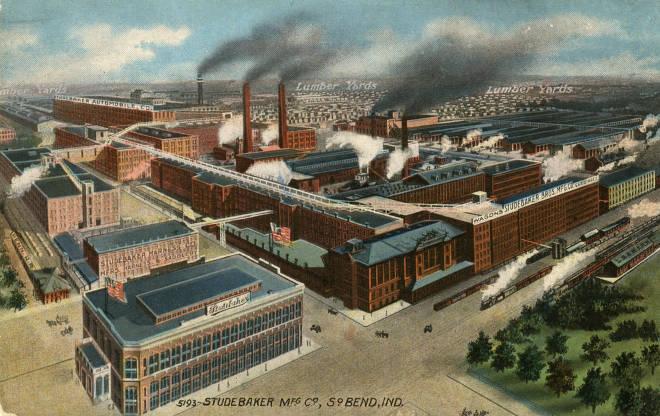
Then the bottom fell out.
By the mid-1960s, the Studebaker shutdown became the city’s defining story — so dominant that for half a century you couldn’t mention South Bend without someone sighing, “well, you know… when Studebaker left.” In 2011, that narrative was so entrenched that Newsweek listed South Bend among the “Dying Cities of America.” The label stung not because it was mean, but because it confirmed what many already believed: it was over.
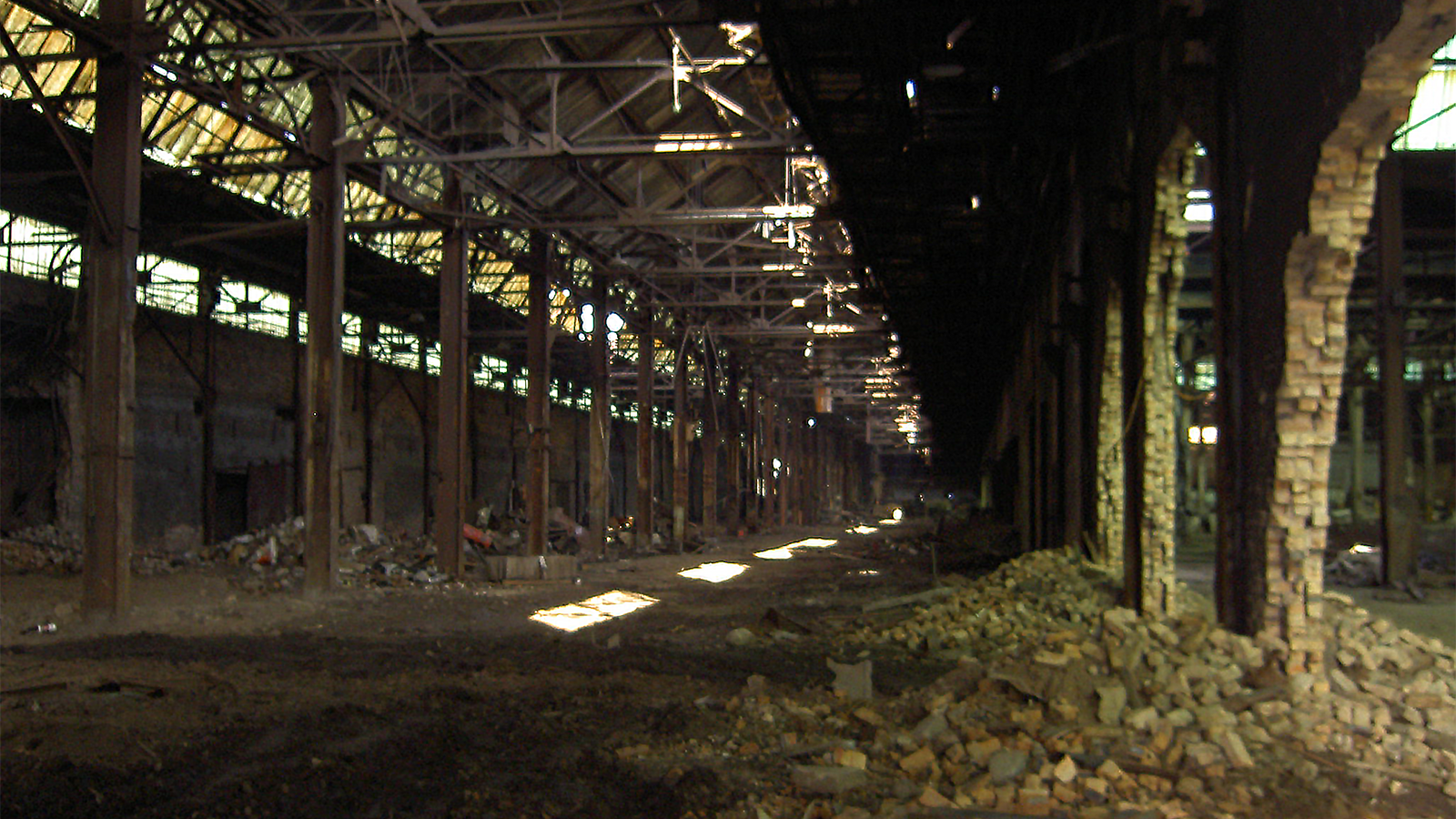
Yet, if you spend time in South Bend today, you’ll rarely hear Studebaker come up at all. At least, that's what Mike Keen told me. Keen is a local. He’s also a former university professor-turned-incremental developer. Most importantly, he’s part of South Bend’s revival. It’s not that the wound has vanished, he explains. It’s still part of the city’s story, but it’s no longer the story of South Bend. It’s a part of history. Eventually, he hopes, it’ll be a footnote.
For decades, the city was frozen in a narrative that cast the past as destiny. Today, it behaves like a place that understands the past is the past and the present is where the future gets built.
The Next Best Time To Plant a Tree is Today
Keen’s work exemplifies this shift. After the 1,000 Homes in 1,000 Days initiative concluded, his neighborhood was pockmarked with empty lots. The program had been pitched as blight removal, targeting streets lined with dilapidated homes. Those homes were indeed eyesores — they attracted crime and reinforced the city’s low morale — but demolishing them left entire blocks hollowed out, with no immediate plans to rebuild on the newly vacated lots.
Instead of waiting for a master plan or a single catalytic investment, Keen began assembling homes and vacant parcels one by one. He helped launch the Portage Midtown Initiative and the South Bend GreenHouse, restored neglected homes, cultivated community gardens, and supported local builders learning to tackle small projects themselves. He often refers to these lots collectively as his “farm.”
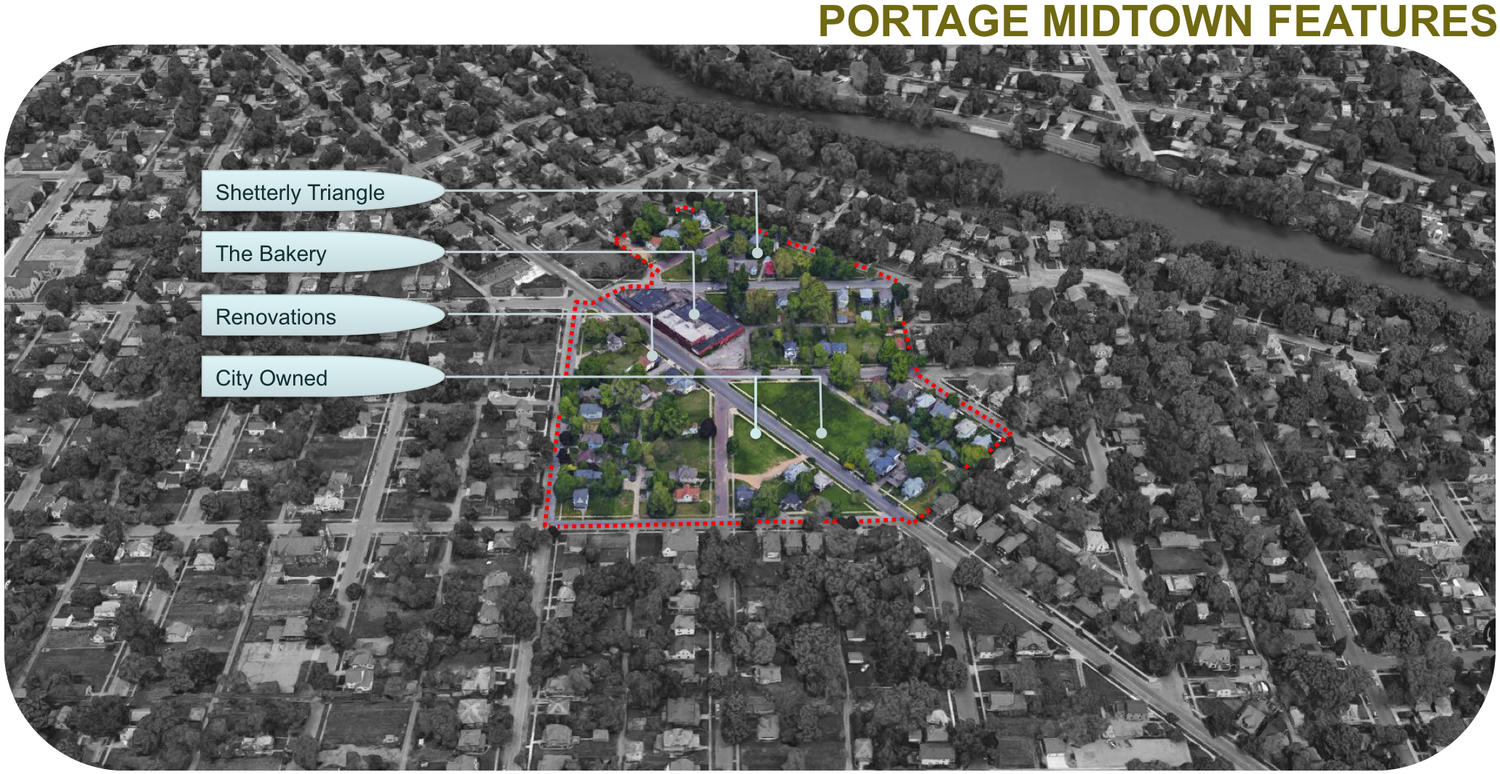
Each small intervention stabilized the block, which encouraged additional investments, drew in new residents, and gradually restored confidence.
All the while, he was hosting gatherings at his own home to connect local developers, city officials, contractors, architects, and neighbors. He told me how those home gatherings grew from five to twelve to sixty to nearly a hundred people in a blink. The guiding philosophy was simple but radical: development is most effective when it is inclusive, collaborative, and rooted in a deep understanding of a specific place. And in order for that to work, everyone had to come sit at the table.
Many Hands, Many Bets
Keen wasn’t alone in this work. There were already dozens of residents committed to revitalizing their neighborhoods. What he helped do, is make them realize they’re all part of an ecosystem.
Barbara Turner of Revive Homes LLC leverages her own resources to restore homes in her community. Sarah Hill, a public library administrator, renovates historic houses through Penny Hill Homes. Consuella Hopkins launched Swella’s Ville, a mixed-use district with homes and office space designed to anchor economic revitalization on the west side. Jordan Richardson and Tony Ruiz are restoring their own neighborhoods, rebuilding homes, and creating opportunities for residents historically shut out of ownership. Each project strengthens the next, creating a network of care and action. And each of these developers shares a simple mantra: if I can do this, anyone can.
Keen’s initiative helped surface and connect these existing efforts, creating a collaborative ecosystem where knowledge, contractors, lenders, and technical expertise circulate openly. Keen calls this approach “finding your farm”: pick a manageable area, commit to it for the long haul, and engage deeply with neighbors and local stakeholders. This networked approach transforms development into something more akin to community organizing.
By working this way, developers can identify undervalued opportunities, build trust, and create a virtuous cycle where each project strengthens the next. As Keen told Strong Towns years ago, “I see the small-scale development approach as a form of DNA… If you have a dandelion seed, a bird can drop it anywhere, and it’s going to create dandelions. Unless something is really wrong with that place, something will grow.”
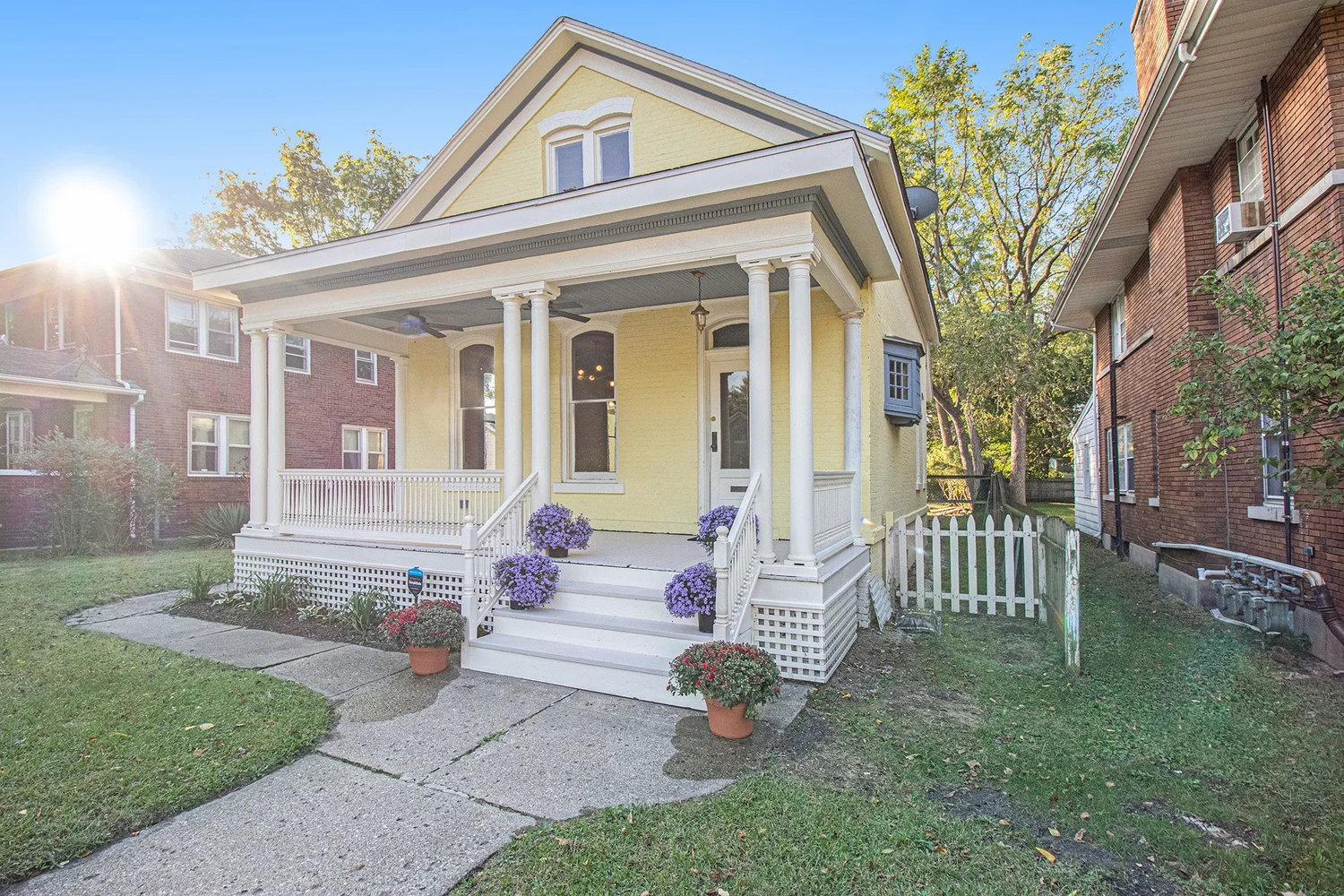
Today, what sets South Bend apart from its Studebaker-era past is the distribution of investment and effort. One factory once anchored the city, so its failure brought everything else down with it. Today, the city’s revival is built on many hands, many bets.
The city itself has become a facilitator. Champions like Tim Corcoran, the city’s Director of Planning, revisited the policies and codes that were holding the city back. Eventually, the creation of the Department of Economic Empowerment created a pathway for technical support and connected small developers to contractors, lawyers, and lenders. Workshops like Build South Bend teach the nuts and bolts of small-scale development, giving residents the tools they need to stabilize and activate their own blocks.
South Bend’s revival is not a miracle. It’s the result of ordinary people taking ownership of their city, learning from failure, sharing knowledge, and acting where the system has failed to act. And in that, it provides hope — and a model — for cities across the country.
Step inside South Bend’s revival in the latest episode of Stacked Against Us. And explore the Housing-Ready City Toolkits to see how your community can grow stronger, block by block.

In Hallowell, Maine, families walking or biking to Hall-Dale Elementary face a daunting task: crossing the intersection of Central and Hillcrest streets, where drivers speed over a blind hill and sidewalks are nowhere to be found.
It’s a well-known hazard, and one that didn’t seem like it would be addressed any time soon. That’s why the Local Conversation Strong Towns Hallowell decided to act.
All of the group’s members are parents, and they knew from experience how dangerous the area was. Their first step was to prove that danger with data. Using resources from Strong Towns’ Crash Analysis Studio, they conducted a speed study and found that over 80% of drivers were speeding. Over 20% were going more than 10 mph over the speed limit.
The blind hill and lack of sidewalks made these high speeds even more dangerous. “Even if someone decides to be nice and, ‘Oh, I’ll go give a wide berth to the pedestrians and do it safely,’ because of the blind crest, they have no way of knowing if there’s another vehicle going over 40 mph in the other direction that’s going to hit them head on,” Dafydd Holbrook-Pronovost told a local newspaper.
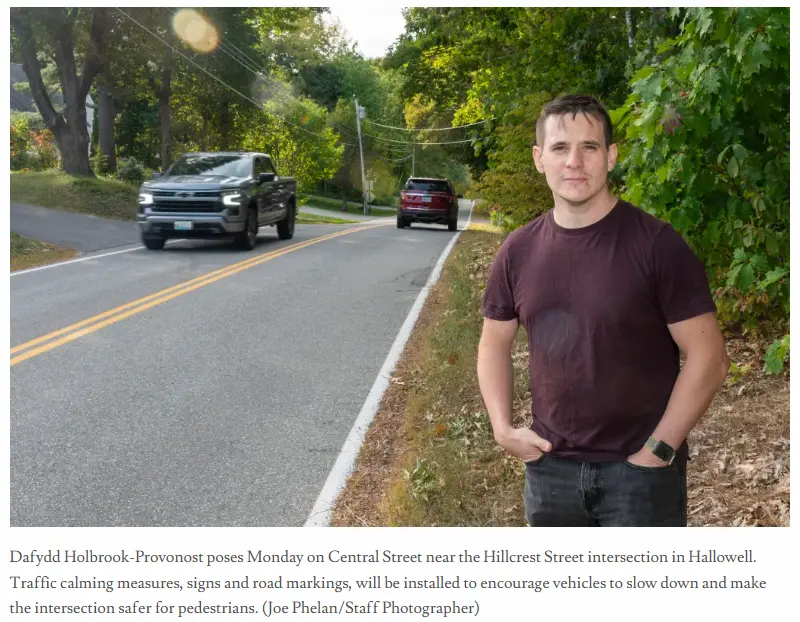
Dafydd is the leader of Strong Towns Hallowell, and he took the lead in developing a plan to address these dangers. Drawing on his experiences in the area and a traffic-calming guide from the Maine Department of Transportation, he identified strategies that could make the area safer. He then brought those strategies to the rest of the group for discussion and iteration.
“Maine DOT employs a single active transport planner, who was highly responsive and enthusiastic, encouraging us to strive for simplicity in our plan,” Dafydd told Strong Towns. The group took the advice to heart. Their finalized plan was very simple: Have volunteers use paint and flexible delineators to narrow the roadway, which will encourage drivers to slow down. The whole project could be done for about $300, which the Local Conversation planned to fund themselves.
- You might want to read: The Power of Paint in Street Transformation
After gathering community feedback and signatures for a petition of support, Strong Towns Hallowell submitted their plan to the city council and transportation committee in August 2024. The planning and community outreach had only taken two months, and the group hoped they’d be able to move just as quickly into implementation.
However, the process proved slower and more complicated than anticipated. Strong Towns Hallowell didn’t get a response from the city until March 2025. In the meantime, the group focused on building momentum within the community. They partnered with the local parent-teacher organization to coordinate the city’s first Walk, Bike, and Roll to School Day in October 2024. Eighteen families participated in the event, which garnered attention from the local news.
When the transportation committee finally met to discuss the plan in April 2025, more difficulties emerged. The committee agreed with the goal of slowing traffic but chose not to move forward with the flexible delineators, which Dafydd described as “the most effective, cheapest, and easiest to implement aspect of our plan.”
Instead, the city chose a more conventional approach: updated pavement markings and new signage installed by the Public Works Department. This raised the total cost to $1,500, five times the group’s original estimate. Fortunately, Strong Towns Hallowell was able to win a grant from the Elsie & William Viles Foundation to cover the cost.
The Public Works Department completed the project installation in late September 2025 — over a year after Strong Towns Hallowell submitted their proposal. One week later, the Local Conversation took part in the second annual Walk, Bike, and Roll to School Day, which drew more than 36 families. The changes made the corridor safer than it had been before — a meaningful step forward — but it wasn’t quite the transformative improvement the group had originally envisioned.
“There has been a slight decrease in average speeds on this section of road,” Dafydd told Strong Towns. “But a significant number of vehicles are still driving at unsafe speeds, and it still feels stressful to walk along this section of road.”
Even so, the project is a victory for the community: residents identified a problem, organized their neighbors, worked through a challenging process, and achieved real, tangible change. While the outcome may not be perfect, it demonstrates what is possible — and leaves the door open for continued improvements in the future.
For anyone considering a similar project in their own community, Dafydd offers three pieces of advice:
- Understand that very small municipal governments have extremely limited capacity, which leads to long project timelines. While not ideal, “it may be better to ask forgiveness than permission,” Dafydd suggested.
- When applying for a grant, emphasize the relatively low cost and high impact of your project.
- Work with other local groups on bigger projects to multiply your impact.
Despite the challenges they faced, Strong Towns Hallowell successfully lowered speeds near a dangerous intersection. They also built strong relationships with community members, other local organizations, and members of the local government. These relationships will give them more influence in future decisions, helping them make their city safer one step at a time.
[[divider]]
Responsible cities analyze traffic crashes to save lives. Yours can too.
Adopt the Crash Analysis Studio model and build a response focused on preventing future harm, not just assigning blame.

Get the Email Newsletter